
Skip to content

The AI Governance Platform for Responsible AI Adoption

Ensure that your data and models meet regulatory and ethical requirements with an AI governance software platform designed for AI TRiSM and SPM.

AI Governance Platforms for Responsible AI: Key Takeaways

AI governance requires continuous, automated control. Static policies cannot keep pace with AI systems that evolve across training, deployment, and runtime environments.

Data visibility is the foundation of responsible AI. Organizations must discover, classify, and monitor data across models, pipelines, and environments to reduce risk.

AI TRiSM and AI SPM are critical for governance at scale. Together, they provide trust, risk management, and continuous security posture monitoring for AI systems.

Shadow AI and unauthorized usage create hidden risk. Organizations must detect and govern unsanctioned models, copilots, and third-party AI tools.

Access control and Zero Trust must extend to AI systems. Governance requires enforcing who can access, use, and process data across AI infrastructure.

Responsible AI governance enables innovation, not just compliance. Strong governance improves transparency, reduces risk, and supports scalable AI adoption.

How BigID AI Governance Platform Powers AI TRiSM and AI SPM

Agentic AI-powered capabilities to secure and govern your data — from training to deployment and beyond.

BigID combines AI TRiSM (Trust, Risk, and Security Management) and AI SPM (AI Security Posture Management) with intelligent, agentic features and AI agents to automate the governance and protection of your data and models.

As a comprehensive AI governance solution, BigID integrates trust, mitigates risk, and maintains security across your environments at scale, supporting AI innovation with features such as:

AI Asset Discovery & Inventory

  • Automatically find and map all AI-related assets across your enterprise, whether in models, copilots, training datasets, prompts, or third-party tools.
  • Maintain a real-time, centralized view of where tools are being used, how they’re deployed, and what data they touch, keeping visibility across every AI system.
  • Get a holistic view of your data assets so you can perform better risk assessment across environments.
  • Improve your visibility to make internal audits and regulatory checks quicker and smoother.

Training Data Discovery & Classification

Shadow AI Detection & Risk Remediation

  • Achieve proactive AI risk management with the platform’s native detection and response capabilities.
  • Uncover unauthorized usage, rogue models, and unsanctioned copilots operating across your organization.
  • Detect emerging threats and automate remediation actions to contain and manage risk before it grows.

Access Management

  • Get more control over who can view, consume, and process your data.
  • Define and implement access control policies to restrict access to business information.
  • Enforce Zero Trust principles and define and enforce access controls across AI infrastructure with a unified layer of governance.
  • Ensure permissions are in line with business purpose and compliance requirements.

AI-Driven Data Governance

  • Automate the process of data classification, tagging, and cataloging across environments.
  • Ensure that data is safe, compliant, and ready for AI use.
  • Apply policies by sensitivity, purpose, or data type to ensure appropriate use and reduce risk exposure.
  • Improve data hygiene and support governance for GenAI, copilots, and large language models.

AI Security Posture Monitoring

  • Continuously monitor model behavior and data access patterns to track usage.
  • Generate real-time alerts in case of detected violations.
  • Get continuous assurance and actionable insights
  • Maintain an up-to-date security posture that reduces exposure and improves resilience across AI projects.

Regulatory Compliance Automation

  • Automate policy enforcement and demonstrate compliance with evolving AI regulations, including NIST AI RMF, the EU AI Act, and ISO/IEC 42001.
  • Make your model development, data usage, access control, and lineage fully auditable.
  • Build trust and transparency into your operations and meet global compliance requirements while satisfying expectations from any regulator overseeing AI usage.

See How BigID Powers Responsible AI Governance

Use AI With Confidence Using the BigID AI Governance Software

BigID helps organizations govern AI across critical use cases. It combines automated policy enforcement, continuous monitoring, and risk-aware data governance.
From Generative AI oversight to regulatory compliance, the data governance software helps enterprises manage risk and operationalize responsible practices. It provides the data transparency needed to maintain control at every stage of the AI lifecycle.

Organizations are becoming increasingly reliant on AI governance tools and platforms like BigID to maintain consistent oversight as AI adoption expands across various departments and environments.

Here are some of the sectors that have benefited from it.

AI Governance in Financial Services – Autonomous Fraud Detection with Oversight

Banks rely on advanced analytics and models to flag and stop fraud in real time—but not every transaction is black and white. With BigID, financial institutions can let AI act fast on clear-cut threats, while handing off potentially ambiguous cases to human analysts.

Such institutions are also required to provide an auditable trail of data and decisions. Behind the scenes, BigID keeps everything traceable: which models make which decisions, what data they use, and whether they follow financial regulations like SOX and GDPR.

AI Governance in Healthcare – AI-Powered Diagnostics with Ethical Guardrails

AI is transforming diagnostics by going through scans and reports to determine potential causes faster than human doctors. However, medical data handling and decision-making must be handled with care. You need to be confident that every AI recommendation is accountable, ethical, and aligned with standards like HIPAA.

BigID helps healthcare organizations govern how AI tools handle sensitive data by flagging potential bias and escalating uncertain diagnoses for human review.

The result? Faster insights, better patient care.

AI Governance in Autonomous Systems – Real-Time Compliance for AI Decision-Making

Autonomous AI, whether a self-driving vehicle or a robotic system on the factory floor, needs to make dynamic decisions that are within strict safety and compliance limits.

BigID helps ensure those decisions stay within the lines. The platform uses real-time monitoring, explainability, and dynamic policy enforcement to support scalable AI deployments and keep systems operating responsibly.

These capabilities highlight precisely why modern organizations choose to adopt AI governance tools and technologies to oversee increasingly autonomous systems.

What Is AI TRiSM?

AI TRiSM is a framework that helps organizations use the technology in a manner that’s trustworthy, responsible, and secure. As its name suggests, it’s the management of AI trust, risk, and security.

The term was coined and defined by Gartner, and is made up of four pillars or principles:

  • Explainability and model monitoring
  • ModelOps, or the process of managing the lifecycle of the AI model
  • AI application security
  • Privacy

BigID supports AI TRiSM by providing the AI governance tools needed to:

  • Discover and inventory models and data, so you can effectively monitor and govern them
  • Assess and mitigate model-specific risks
  • Enforce policies across access, usage, and security
  • Ensure transparency, auditability, and regulatory alignment

Get the AI TRiSM Guide to Manage AI Risk and Security

What Is AI SPM?

Much like DSPM, AI Security Posture Management is a strategy for continuously monitoring and improving the security state of your systems. The features and capabilities of an AI SPM solution include:

  • AI inventory management
  • Data security
  • Operational security
  • Risk detection and prioritization
  • Runtime monitoring
  • Compliance and governance
  • Proactive remediation

Additionally, the solution should also be developer-friendly, with the ability to integrate with cloud platforms for easy scalability.

BigID enables AI SPM through:

  • Real-time visibility into data access and model behavior
  • Alerts for violations, anomalies, and unauthorized use
  • Automated enforcement of least-privilege and Zero Trust principles
  • Tools to assess and reduce exposure across AI environments

Together, AI TRiSM and SPM form the foundation of scalable, responsible AI governance that is supported by modern AI governance tools.

Understand the Real AI Divide: SLMs vs LLMs

Why Choose BigID as Your Governance Platform for AI?

BigID combines the power of AI TRiSM and SPM to give you comprehensive data management and governance capabilities.

Know Where Your Data and Assets Are

The platform automates the process of data and asset discovery across all your environments, accelerating your AI initiatives. It can help you locate all business information, regardless of where it’s located — whether it’s the cloud, on premises, or even hidden within shadow IT and shadow AI.

Classify Data by Sensitivity and Priority

Once it has been located, BigID tells you exactly what data you own, how sensitive it is, and where it’s stored. The platform significantly reduces your risk of privacy violations by keeping you informed of the nature and residence of your AI data.

Manage Data Risk

BigID’s AI-powered governance platform assesses your data risk based on its classification. Depending on whether the information is sensitive, personal, confidential, or public, it will help you identify risks and design mitigation strategies, such as cleaning data sets, setting access controls, and using them securely in your workflows.

Implement Access Control

With your data mapped and classified, the platform helps you dynamically enforce role-based data access governance policies. BigID follows a Zero-Trust approach to ensure all your AI data is only viewable by those who have the permission to see it.

Monitor Processes and Get Informed About Violations

The platform then constantly monitors your AI data to detect policy violations, keeping you secure and on the right side of legal requirements.

These capabilities form part of BigID’s wider AI governance solutions, designed to support responsible AI adoption at scale.

What Is AI Governance?

AI technologies are becoming more powerful and widely adopted. As such, they also introduce new risks. These range from bias and data leakage to lack of transparency, accountability, and regulatory compliance.

AI governance refers to the frameworks, standards, and safeguards for AI systems. Its purpose is to ensure that any models are developed, deployed, and monitored according to legal, ethical, and operational guidelines. AI governance policies help organizations reduce risk, build trust, and ensure the responsible use of AI at scale.

Effective governance relies on AI governance software and supporting AI governance tools and platforms that help organizations enforce policies, monitor usage, and maintain accountability across all AI systems.

AI governance policies are critical for helping organizations to reduce risk, build trust, and ensure that wide-scale AI is being used responsibly.

AI Governance Best Practices

Avoid Risks with AI-Led Solutions

AI is becoming more embedded in business operations, but it comes with certain risks. BigID helps mitigate AI risks through automated controls that can detect and flag any potential violations before they become a problem.

This AI governance solution gives you visibility into your data across all environments and assets, helping you enforce policies.

The platform offers the controls to:

  • Reduce bias and discrimination in decision-making by flagging instances for human oversight
  • Eliminate data privacy violations, especially with unstructured or untagged data, by mapping and classifying all AI data
  • Avoid penalties that come with regulatory non-compliance due to the lack of oversight or explainability with a fully auditable and traceable governance system
  • Get rid of model drift, where AI systems behave unpredictably over time, by maintaining data accuracy, completeness, and integrity
  • Discover shadow AI — unauthorized models or tools introduced without governance — and include them in your governance and management program
  • Prevent data leakage through copilots, LLMs, or vector stores by flagging sensitive data and applying appropriate safeguards to protect it

Follow the Principles of Responsible AI Governance

Effective AI governance is more than just checking boxes for compliance. It’s about protecting your business, your customers, and your reputation. It ensures your AI systems are:

  • Transparent: You know what your AI is doing and why
  • Accountable: You can trace actions, decisions, and data use
  • Secure: Sensitive data isn’t exposed, leaked, or misused
  • Ethical: AI aligns with your values and regulatory standards
  • Scalable: Governance keeps pace with your growth

Apply these principles effectively, and you directly address the risks introduced by modern AI. They keep your AI systems operating with integrity, security, and compliance. With the right governance platform, you can ensure that your AI solution is a strategic advantage, not a regulatory or security liability.

Manage AI Risks With BigID

Why Adopt AI for AI Governance

Here are some reasons why using artificial intelligence to govern AI is a good idea:

Keep Up With the Processing Speed of AI

Humans cannot keep up with the processing power of modern computers. Smart algorithms can complete rules-based tasks much faster than even the most experienced and efficient employee.

AI systems are much more complicated, so you can’t use manual oversight and static policies to keep them in check. AI can follow data through paths and storage areas where traditional tools can’t go. Whether it’s unstructured data or assets hidden in shadow AI, it can find them and manage the risks that come with them.

Scale Up Easily

SaaS, cloud services, and third-party tools are helping your organization grow much faster. As it expands, you generate vast amounts of data that you feed into your AI systems. Discovering and classifying these volumes of information manually is impossible, but AI can sift through it in seconds.

Apply Proactive Self-Governance

Agentic AI doesn’t just automate tasks; It can automate entire processes and monitor systems with minimal human oversight. If it detects governance issues, it can take policy-driven actions to mitigate or resolve them.

The most important part is that it can apply governance rules at the point of data use—by model, by user, by context. Unlike hardcoded policies, AI-powered AI governance adapts to evolving regulatory frameworks and business needs.

Empower Human Oversight

Using artificial intelligence doesn’t mean removing people from the loop. The systems still need humans to oversee them. AI governance simply makes it easier to do so.

AI governance platforms help you make better decisions, faster. They offer automated alerts, pre-classified data, and real-time risk scoring. This means you can set the rules and let the tool do its job. You only need to intervene when the system flags an issue. It’s still your people who are controlling your AI data and assets and their governance; they just get a helping hand from AI.

Assess Your AI Governance and Risk Posture

AI Governance Software FAQs

What is AI governance software?

In its simplest terms, AI governance software is a specialized category of tools and platforms that are designed to help organizations manage, monitor, and control the development and deployment of AI systems.

These solutions provide the technical infrastructure that is required to keep AI technologies operating ethically, safely, and legally, while simultaneously aligning with business objectives.

Why do organizations need AI governance software?

There are various risks, ethical dilemmas, and regulatory complexities associated with artificial intelligence. AI governance software helps to manage these, ensuring that systems are transparent, unbiased, and compliant with laws such as the EU AI Act. This helps to build trust and allows for innovation that is both sustainable and responsible.

What capabilities should an AI governance solution include?

Any effective AI governance should include centralized inventory management, automated risk and bias assessment, and ongoing monitoring to ensure safety and compliance.

Key capabilities include model documentation, explainability tools, human-in-the-loop oversight, regulatory compliance tracking, and robust data privacy controls throughout the entire AI lifecycle.

How do AI governance tools help with regulatory compliance?

These tools facilitate regulatory compliance by providing automated, auditable, and transparent oversight of AI systems throughout all processes. They ensure that businesses adhere to legal standards such as GDPR and the EU AI Act by managing risk, reducing bias, maintaining data lineage, and enabling real-time monitoring and reporting to align with regulatory demands.

What risks can AI governance software help prevent?

This software prevents key operational, legal, and reputational risks by providing oversight and transparency while maintaining control over AI systems.

The key risks that are prevented include data privacy breaches, bias and discrimination in algorithms, security vulnerabilities, regulatory non-compliance, and operational failures that might occur from instances such as incorrect automated decisions.

How does AI governance work with generative AI and LLMs?

For generative AI and LLMs, governance involves a structured framework of policies, processes, and technologies that are in place across the whole lifecycle. It goes beyond traditional IT to more effectively manage dynamic risks such as hallucinations, bias, and data leaks.

What is the difference between AI governance and AI security?

Governance and security go hand in hand when it comes to trustworthy AI. Governance defines the specific policies, ethical frameworks, and compliance requirements for AI usage and management. Security focuses more on protecting AI systems from technical threats like unauthorized access, data poisoning, and malicious inputs.

Contents

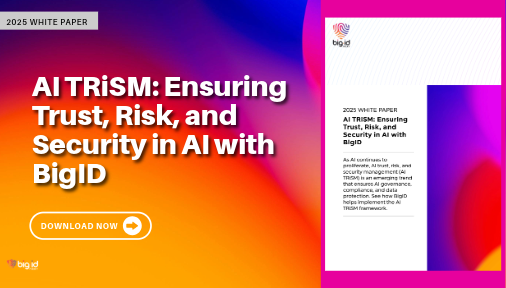
AI TRiSM: Ensuring Trust, Risk, and Security in AI with BigID

Download the white paper to learn what AI TRiSM is, why its important now, its four key pillars, and how BigID helps implement the AI TRiSM framework to ensure that AI-driven systems are secure, compliant, and trustworthy.

Download White Paper