
Enterprise security is entering a new phase—one where AI systems don’t just assist teams, but act autonomously through agentic workflows. As organizations operationalize agentic AI, security can no longer rely on siloed controls or bolt-on features. Securing agentic AI requires a new architecture—one that unifies data security, AI governance, identity enforcement, and runtime protection. The Unified Agentic Defense Platform (UADP) is emerging as a framework for delivering autonomous, governed threat prevention across the full spectrum of agentic AI systems.
TL;DR: What Is a Unified Agentic Defense Platform?
A Unified Agentic Defense Platform (UADP) is an emerging cybersecurity architecture designed to secure agentic AI systems end-to-end. It converges data security (DSPM + DLP), AI security posture management and governance, identity controls across human and non-human actors, runtime agent protection, and intent-aware Just-In-Time enforcement—enabling autonomous threat prevention with unified context and guardrails.
What Is a Unified Agentic Defense Platform (UADP)?
A Unified Agentic Defense Platform (UADP), a term introduced by the analyst team at Software Analyst Cyber Research, is an emerging security architecture built to address the full spectrum of what it takes to secure agentic AI systems. As autonomous agents gain the ability to access data, make decisions, and take action, AI security is no longer a standalone feature—it requires unified prevention, governance, and real-time enforcement across domains.
In practical terms:
UADP unifies AI governance, sensitive data intelligence, identity enforcement, and runtime agent protection into a coordinated architecture for autonomous threat prevention.
Unlike siloed security tools that detect threats in isolation, a UADP architecture connects multiple domains—including:
- AI and workflow security
- Data security and governance
- Identity, endpoint, and workload defense
- Threat intelligence and response operations
The objective is straightforward:
Enable autonomous security agents to act faster and more safely within governed guardrails by operating with unified context—especially sensitive data intelligence.
Want to Go Deeper on the Data Control Plane for Agentic AI?
Unified Agentic Defense Platforms depend on more than automation—they require governed access to sensitive data across AI workflows.
Explore how modern data access governance enables secure, autonomous agentic systems in our whitepaper:
Why Are Unified Agentic Defense Platforms Emerging Now?
Security leaders are facing a convergence of forces:
- Threat actors are increasingly automated and AI-assisted
- Cloud and SaaS sprawl expand the enterprise attack surface
- AI systems introduce new workflows and new data pathways
- Tool fragmentation slows response and creates blind spots
- Automation without governance increases operational risk
At the same time, expectations are shifting.
Security systems are no longer expected to simply alert. They are expected to prevent and control threats autonomously, within defined governance guardrails.
That is the promise of UADP.
Why Autonomous Threat Prevention Fails Without Unified Context
Most enterprises have invested heavily in best-of-breed security tools. The challenge is fragmentation.
In many organizations:
- Threat detection platforms see suspicious behavior
- Identity systems track access and entitlements
- Data teams understand sensitivity and exposure
- Governance teams manage compliance requirements
- SOC teams triage and respond to alerts
When these insights are disconnected, security teams struggle to answer critical questions:
- What data was involved?
- Was it sensitive, regulated, or business-critical?
- Was the identity authorized—or over-permissioned?
- Did the activity violate policy?
- Is an AI workflow using or exposing the data?
- What response is safe to automate?
Agentic AI can only prevent threats effectively when it operates with shared, consistent context across systems.
What Capabilities Converge in a Unified Agentic Defense Platform?
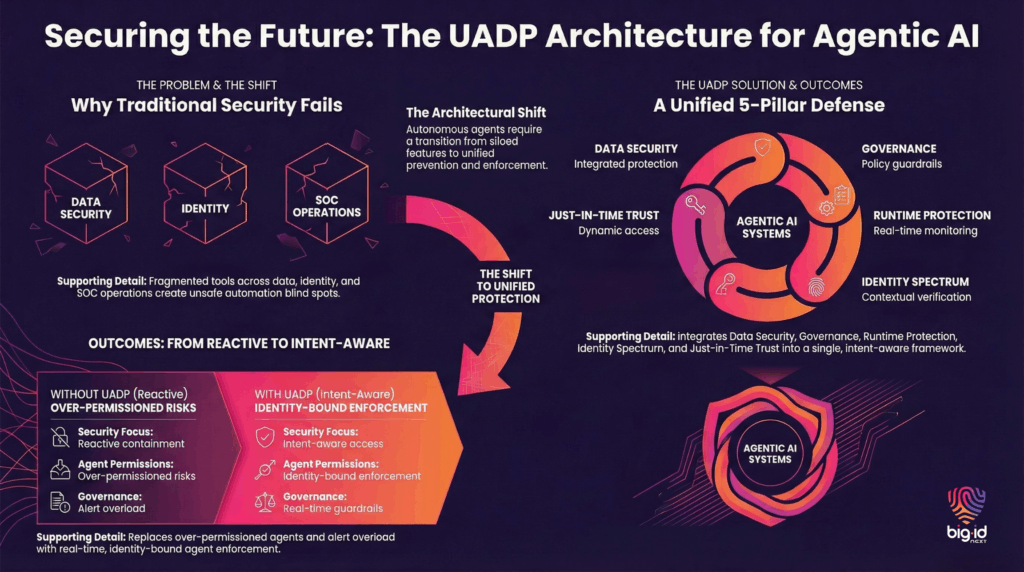
Unified Agentic Defense Platforms reflect the reality that securing agentic AI requires more than one control plane. UADP architectures converge five critical capability areas:
1. Data Security (DSPM + DLP)
Agentic AI systems are only as safe as the data they can access.
UADP platforms unify:
- Sensitive data discovery and classification (DSPM)
- Data loss prevention and policy enforcement (DLP)
- Exposure management and risk prioritization
Data intelligence becomes the foundation for safe autonomous action.
2. AI Security Posture Management and Governance
Agentic AI introduces new risks: unapproved training data, uncontrolled retrieval, and opaque decision pathways.
UADP includes:
- AI governance guardrails
- Policy enforcement for AI workflows
- Monitoring of model and agent data usage
- Continuous AI security posture management
3. Runtime Prompt and Agent Protection
Agentic AI systems operate dynamically, which creates runtime attack surfaces.
UADP addresses:
- Prompt injection and manipulation
- Unsafe agent actions at runtime
- Endpoint-level protection for AI execution environments
- Continuous control beyond static policies
4. Identity Security Across Human and Non-Human Actors
Modern enterprises must secure not just employees, but agents, services, and machine identities.
UADP unifies identity defense across:
- Human users
- Non-human identities (NHIs)
- Autonomous agentic identities
This ensures every actor is governed consistently.
5. Intent-Aware Just-In-Time Trust Enforcement
Static access models fail in autonomous environments.
UADP enables:
- Intent-aware access decisions
- Real-time enforcement based on risk and context
- Just-In-Time Trust controls for sensitive data and agent actions
Enforcement decisions must account for both user intent and the sensitivity of the data or action being requested.
Prevention becomes adaptive, not reactive.
What Does “Agentic AI” Mean in Cyber Defense?
Agentic AI goes beyond traditional automation.
Traditional automation relies on:
- Static if-then rules
- Ticket routing
- Predefined playbooks
Agentic defense refers to AI systems that can:
- Reason across identity, threat, and data context
- Decide what action is appropriate
- Coordinate across tools and workflows
- Act autonomously within governance boundaries
The goal is reducing time-to-containment while ensuring decisions align with real business risk.
Why Is Data Intelligence Critical for Autonomous Threat Prevention?
Agentic prevention depends on prioritization.
Prioritization depends on sensitivity.
A platform might detect:
- Suspicious access to cloud storage
- Anomalous downloads
- Privileged identity misuse
- An AI workflow calling a dataset
But severity changes instantly when the system understands:
- The data contains PII, PHI, or financial records
- The dataset is regulated under GDPR or HIPAA
- The data represents crown-jewel intellectual property
- The dataset feeds an AI model or RAG pipeline
- Access violates policy or entitlement rules
Agentic AI without unified sensitive data intelligence is unsafe.
Data context is the safety layer for autonomous control.
How Does DSPM Fit Within a Unified Agentic Defense Platform?
DSPM and UADP overlap—but they are not the same.
DSPM answers:
Where is our sensitive data, how exposed is it, and what should we fix first?
UADP answers:
How do we unify autonomous threat prevention and control across the enterprise?
The relationship is clear:
- DSPM is a core pillar of UADP’s data security layer
- UADP is the broader unifying architecture
- DSPM provides the context agentic defense needs to act safely
Rather than framing this as “DSPM vs UADP,” it is more accurate to say:
DSPM is foundational to Unified Agentic Defense.
How Unified Agentic Defense Works With Data Context
Scenario 1: Cloud Storage Exposure Becomes Controlled Prevention
An agent detects public access to a storage bucket.
Without data context:
It’s another misconfiguration ticket.
With unified data intelligence:
The platform recognizes regulated customer PII and initiates autonomous control:
- Restricts access within policy
- Alerts compliance and data owners
- Triggers tracked remediation workflows
- Evaluates downstream AI exposure risk
Scenario 2: AI Workflow Attempts to Use Restricted Data
A team connects an AI agent to an internal dataset.
Unified agentic defense can:
- Detect sensitive data usage
- Enforce AI governance policies
- Gate deployment through approvals
- Prevent training or RAG leakage
Scenario 3: Identity Misuse Becomes Data-Aware Containment
A privileged identity downloads files at scale.
Unified defense correlates:
- Identity risk
- Entitlement posture
- Sensitive data exposure
The platform can:
- Enforce Just-In-Time access controls
- Revoke risky permissions
- Trigger SOC workflows tied to impacted data domains
How BigID Aligns With the Unified Agentic Defense Platform Vision
In a UADP architecture, data security and governance form the foundation that makes autonomous agentic defense possible.
BigID strengthens this pillar by delivering:
- DSPM-driven sensitive data discovery and classification
- Exposure management and risk prioritization
- Privacy, compliance, and policy enforcement
- AI governance controls that prevent sensitive data misuse in agentic workflows
BigID does not replace runtime security or endpoint defenses. Instead, it provides the sensitive data intelligence and governance layer that unified agentic defense systems rely on to act safely and with precision.
As Unified Agentic Defense Platforms evolve, the role of a centralized control layer becomes increasingly critical. Independent research reinforces this architectural positioning. In recent research on Unified Agentic Defense Platforms, one analyst firm noted:
“For the CISO, BigID represents the Control Plane approach to the Unified Agentic Defense Platform (UADP) market.”
This perspective highlights the importance of a unified data and governance control plane—one that informs identity enforcement, AI guardrails, and runtime protection with consistent context.
Key Takeaways
- UADP secures agentic AI systems end-to-end
- DSPM + DLP provide the sensitive data foundation
- Runtime prompt protection reduces agent manipulation risk
- Identity spans human + non-human + autonomous agents
- Intent-aware JIT enforcement enables real-time control
Frequently Asked Questions (FAQs)
What is a Unified Agentic Defense Platform (UADP)?
A UADP is an emerging cybersecurity architecture focused on autonomous, agentic threat prevention and control across AI workflows, data security, identity defenses, and threat response operations.
Is UADP a replacement for SIEM or SOAR?
Not necessarily. UADP integrates with SIEM, SOAR, and SOC workflows to coordinate autonomous prevention and control with unified context.
What does agentic AI mean in cybersecurity?
Agentic AI refers to AI systems that can reason, decide, and act autonomously within governance guardrails—triaging threats, investigating risk, and executing preventive controls.
Where does DSPM fit within UADP?
DSPM is a core component of the data security pillar in UADP. It provides sensitive data discovery, classification, and exposure intelligence that enables safe autonomous defense.
Why is data intelligence critical for autonomous threat prevention?
Because threat severity depends on what data is involved. Unified data intelligence helps agentic systems prioritize correctly and apply controls aligned with business and compliance risk.
How does UADP support AI governance?
UADP frameworks include AI workflow governance to ensure autonomous agents and AI systems operate within policy, avoid sensitive data misuse, and remain auditable.
Final Thought: Autonomous Defense Depends on Unified Data Context
Unified Agentic Defense Platforms represent the future direction of cybersecurity: autonomous prevention and control across AI, data, identity, and operations.
But autonomous defense only works when grounded in unified sensitive data intelligence.
For security and data leaders, the path forward is clear:
The future of agentic threat prevention is data-aware, unified, and governed.
See How Data Intelligence Powers Unified Agentic Defense
Understanding Unified Agentic Defense Platforms is one thing. Operationalizing the data intelligence that makes autonomous threat prevention safe and effective is another.
If you’re evaluating how to:
- Eliminate sensitive data blind spots across cloud and SaaS
- Prioritize incidents based on real data risk—not alert volume
- Govern AI workflows and autonomous agents responsibly
- Strengthen the data security pillar within your UADP architecture
- Align DSPM, Zero Trust, and SOC operations around unified context
Schedule a 1:1 demo to see how BigID delivers the sensitive data discovery, risk prioritization, and AI governance capabilities that power unified, agentic defense.
Author