
Data security posture management (DSPM) has rapidly become essential for understanding where sensitive data lives and how it’s exposed. But as DSPM adoption grows, organizations are running into a hard reality: visibility alone doesn’t reduce risk—remediation does.
Many teams still rely on ticketing systems as their primary remediation mechanism. Findings are identified, tickets are opened, and issues are routed to owners. In theory, this creates accountability. In practice, it creates bottlenecks, alert fatigue, and unresolved risk.
In today’s cloud- and AI-driven data environments, ticketing is not remediation—and it’s not enough to operate at DSPM scale.
The Growing Remediation Challenge in DSPM
Modern data environments are dynamic, distributed, and constantly changing. Sensitive data spans cloud storage, SaaS platforms, data warehouses, file shares, and AI pipelines. Access is no longer limited to users—it includes service accounts, automated workflows, and AI agents.
DSPM tools surface this risk at massive scale. A single assessment can reveal thousands of exposed data objects, misconfigurations, and excessive access paths. The real challenge becomes deciding:
- What actually matters most
- Who should fix it
- How it should be remediated
- And whether risk was truly reduced
Ticket-based workflows were never designed for this level of complexity.
Why Ticketing Breaks Down at Scale
Ticketing systems still have a role—but they cannot serve as the foundation for DSPM remediation.
Too Many Alerts, Too Little Clarity
Security teams are overwhelmed with findings across DSPM, DAM, and cloud security tools. Tickets often lack the data context needed to understand severity, blast radius, or downstream impact—slowing triage and decision-making.
Manual Remediation Can’t Keep Up
Human-driven fixes don’t scale with the volume, velocity, and variety of modern data risk. By the time a ticket is addressed, the underlying exposure may have already changed.
Fragmented Ownership Creates Bottlenecks
Security teams can’t remediate everything themselves. Data owners and application owners are often best positioned to act—but they’re rarely given the context or guidance needed to remediate confidently.
No Proof of Risk Reduction
Closing a ticket doesn’t confirm that exposure was actually eliminated or that new risk wasn’t introduced elsewhere. To remediate at scale, organizations need a different model—one that is flexible, intelligent, and built for data.
What Remediation at Scale Really Looks Like
Effective DSPM remediation requires more than assigning tasks. It requires actionability, flexibility, and intelligence.
At scale, remediation must support:
- Multiple remediation actions depending on risk type
- Automation for common and repeatable issues
- Guided remediation when human judgment is required
- Delegation to the right owners with full context
- Continuous validation that risk has actually been reduced
This is where BigID leads the market.
BigID: Flexible Remediation Built for DSPM Scale
BigID was designed to move DSPM from findings to outcomes—enabling organizations to remediate data risk where it lives, how it makes sense, and at the speed the business requires.
Not all risks should be handled the same way. BigID provides the most flexible remediation options in DSPM, allowing organizations to take action:
- Directly in BigID through native controls
- Across the security stack via integrated workflows
- Delegated to data owners with guided recommendations
Teams can revoke access, delete or mask data, quarantine files, apply encryption, trigger workflows, or assign tasks—often combining multiple actions to fully eliminate exposure.
Intelligent, Guided Remediation Recommendations
BigID doesn’t just surface risk—it helps teams understand what to do next.
Using deep data context and AI, BigID provides intelligent, step-by-step remediation recommendations, explaining:
- Why a data object is risky
- What remediation actions are appropriate
- What impact each action may have
This guidance empowers both security teams and data owners to act faster and with confidence—reducing delays and missteps.
Agentic Remediation: From Alert Fatigue to Clear Priorities
To address alert overload and slow triage, BigID introduces Agentic Remediation.
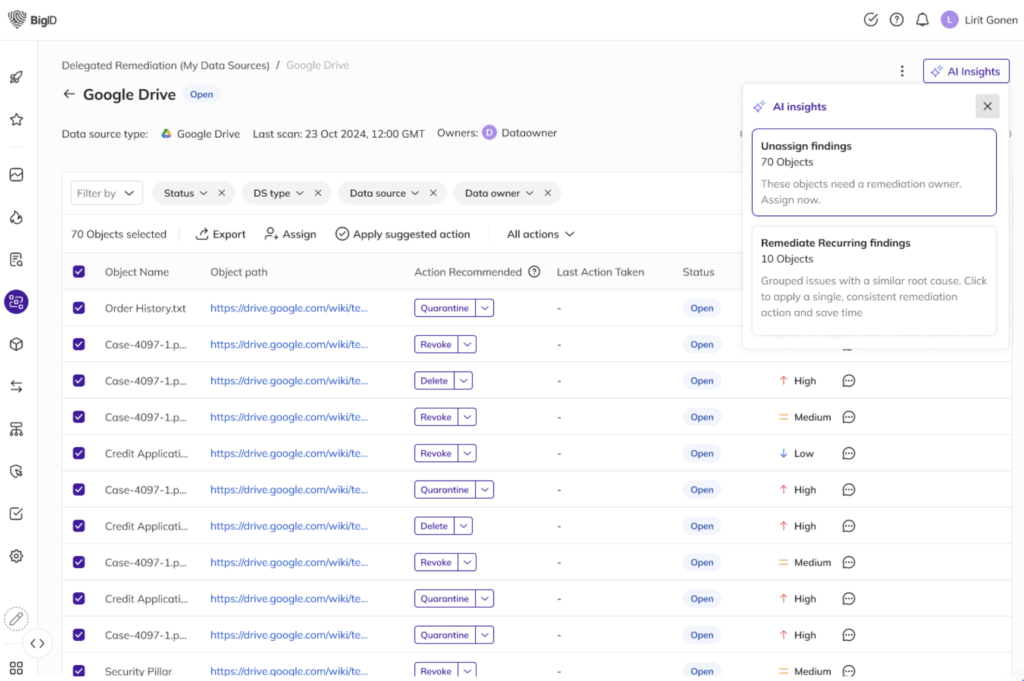
BigID uses AI to:
- Prioritize risky data objects based on sensitivity, exposure, blast radius, access paths, usage, and misconfigurations
- Deduplicate and group related findings to reduce noise
- Identify what truly matters most—and what should be fixed first
From there, BigID delivers agentic remediation guidance, routing prioritized actions to the right teams with auto-generated context and recommended steps.
This shifts remediation from reactive ticket management to proactive, intelligent risk reduction.
Built for Collaboration, Not Bottlenecks
BigID recognizes that security teams can’t remediate everything alone. By routing guided remediation tasks to data and application owners—with clear instructions and business context—BigID removes friction across teams and accelerates time-to-fix.
Continuous Validation and Measurable Outcomes
Remediation doesn’t end with an action. BigID continuously validates that exposure has been reduced and stays reduced over time—providing measurable proof of improvement for security leaders, auditors, and governance teams.
Moving Beyond Tickets to True DSPM Remediation
Ticketing systems were built to track work—not to reduce data risk at scale.
As data volumes grow and AI adoption accelerates, organizations need DSPM solutions that go further:
- From alerts to prioritized action
- From manual effort to intelligent automation
- From task completion to verified risk reduction
BigID delivers this shift with flexible remediation, intelligent guidance, and agentic remediation—turning DSPM insights into real, measurable security outcomes.
Because at DSPM scale, remediation isn’t about managing tickets.
It’s about reducing risk—continuously and intelligently.
Want to learn more? Scheduled a 1:1 with one of our DSPM experts today!
Author