

UK financial institutions operate in one of the most tightly regulated and data-intensive environments in the world.
Banks, insurers, and fintechs manage vast volumes of sensitive data across cloud platforms, SaaS applications, and AI systems. This data fuels innovation, customer experience, and operational efficiency.
It also introduces significant risk.
Sensitive financial data spreads across environments faster than security teams can track or control.
Security leaders must answer critical questions:
- Where does sensitive financial data exist?
- Who can access it?
- Which exposures create regulatory and operational risk?
Data Security Posture Management (DSPM) gives financial institutions the visibility and control required to answer those questions.
At a Glance
• Financial institutions manage large volumes of sensitive data across complex environments.
• Limited visibility and excessive access increase regulatory and operational risk.
• DSPM helps discover, classify, and govern financial data across systems.
• Organizations reduce exposure and meet regulatory expectations with stronger data control.
Best for: CISOs and risk leaders in financial services.
What Is DSPM for Financial Services?
Data Security Posture Management (DSPM) helps financial institutions discover sensitive data, classify it accurately, analyze access risk, and reduce exposure across cloud, SaaS, and unstructured environments.
DSPM focuses on the data itself.
Security teams can:
- discover financial data across all systems
- classify regulated and high-risk information
- understand who can access sensitive records
- take action to reduce exposure
This creates a complete view of data risk across the financial enterprise.
The Financial Data Risk Problem in the UK
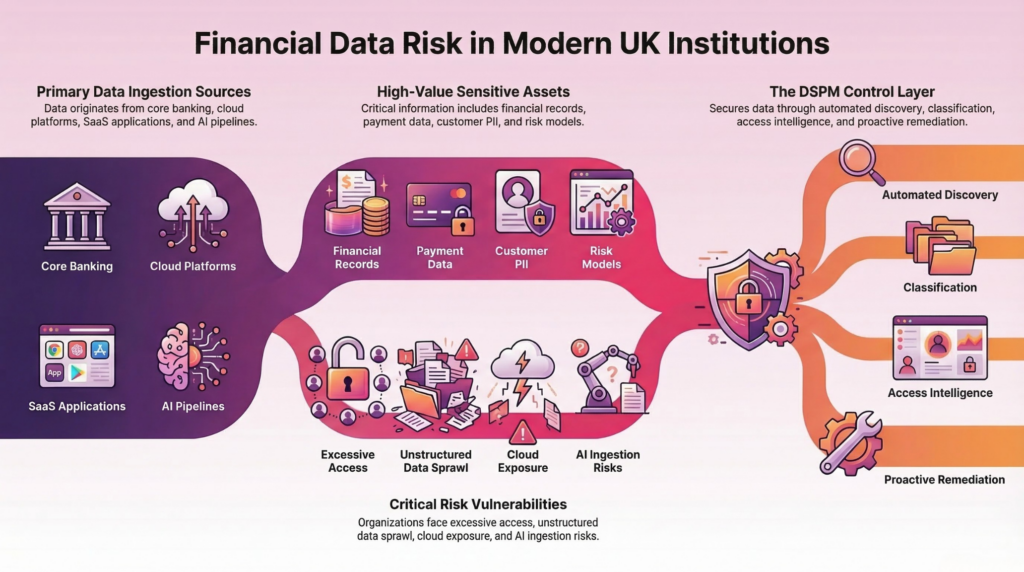
Financial institutions store sensitive data across complex ecosystems.
This includes:
- customer financial records
- payment data
- transaction histories
- credit and risk models
- internal financial reports
This data lives across:
- cloud platforms
- core banking systems
- data warehouses
- collaboration tools
- AI and analytics pipelines
Each system introduces risk.
Security teams often lack visibility into:
- unstructured financial data
- over-permissioned access
- duplicated sensitive datasets
- legacy data stored without governance
Without visibility, risk compounds.
FCA Expectations and Data Governance
UK financial institutions operate under strict regulatory oversight.
The Financial Conduct Authority (FCA) expects organizations to:
- protect sensitive financial data
- maintain strong governance controls
- manage data access and usage
- demonstrate accountability
These expectations require clear visibility into data and access.
DSPM enables organizations to:
- discover regulated financial data across systems
- classify data aligned to regulatory requirements
- identify excessive access and exposure
- enforce governance controls
Security leaders gain the ability to translate regulatory expectations into measurable security outcomes.
Securing Financial Data Across Cloud Environments
Cloud adoption continues to accelerate across UK financial services.
Institutions store sensitive data in:
This creates new risk.
Sensitive financial data spreads across cloud storage without consistent governance.
DSPM helps organizations:
- discover sensitive financial data across cloud environments
- identify exposed storage and mismanaged access
- apply consistent classification policies
- reduce data exposure risk
Security teams gain control over financial data in distributed environments.
Reducing Insider and Access Risk
Many financial data breaches do not originate from external attacks.
They result from:
- excessive internal access
- stale permissions
- uncontrolled data sharing
DSPM provides access intelligence.
Security teams can:
- identify over-permissioned financial data
- detect unusual access patterns
- remove unnecessary access
- enforce least-privilege principles
This reduces one of the most common sources of financial data exposure.
DSPM and AI in Financial Services
AI adoption continues to grow across UK financial institutions.
Organizations use AI for:
- fraud detection
- risk modeling
- customer insights
- automation
These systems rely on large volumes of sensitive data.
Without governance, financial data enters AI systems without control.
DSPM helps organizations:
- discover sensitive data before it enters AI pipelines
- classify regulated financial information
- reduce the risk of data exposure in AI outputs
This ensures AI systems operate on governed, trusted data.
Operationalizing DSPM in Financial Institutions
Successful DSPM programs follow a structured model.
Step 1: Discover Financial Data
Scan all systems to identify where sensitive financial data exists.
Step 2: Classify Regulated Data
Identify financial, personal, and regulated information.
Step 3: Analyze Access Risk
Determine who can access sensitive financial data.
Step 4: Remediate Exposure
Remove access, secure data, and enforce governance controls.
This approach allows institutions to continuously manage financial data risk.
Frequently Asked Questions About DSPM for Financial Services in the UK
1. What is DSPM for financial services?
DSPM helps financial institutions discover sensitive data, classify regulated information, analyze access risk, and reduce exposure across cloud, SaaS, and unstructured environments. It focuses on protecting financial data at scale.
2. Why do UK financial institutions need DSPM?
UK financial institutions manage large volumes of sensitive data across complex systems. DSPM provides the visibility and control needed to reduce risk, meet regulatory requirements, and secure data across cloud and AI environments.
3. How does DSPM support FCA data governance expectations?
DSPM helps organizations discover regulated financial data, control access, and enforce governance policies. This enables institutions to demonstrate accountability and align with FCA expectations for data protection and risk management.
4. What types of financial data can DSPM discover?
DSPM discovers sensitive financial data such as customer records, payment data, transaction histories, credit data, and internal financial reports across cloud, SaaS, and on-prem systems.
5. How does DSPM reduce financial data exposure risk?
DSPM identifies high-risk exposures such as over-permissioned access, unclassified data, and unsecured repositories. Security teams can take action to reduce exposure before incidents occur.
6. How does DSPM help secure cloud data in financial services?
DSPM scans cloud environments to discover sensitive financial data, identifies misconfigured storage and access, and applies consistent classification and governance policies across platforms.
7. Can DSPM help reduce insider risk in financial institutions?
Yes. DSPM analyzes access patterns to identify excessive permissions, stale access, and risky data sharing. Organizations can enforce least-privilege access and reduce insider-driven exposure.
8. How does DSPM support AI data governance in financial services?
DSPM helps organizations discover and classify sensitive financial data before it enters AI systems. This reduces the risk of exposing regulated data in training datasets, analytics pipelines, or AI outputs.
9. How does DSPM differ from traditional security tools in financial services?
Traditional tools focus on infrastructure and network security. DSPM focuses on data. It shows where financial data exists, who can access it, and where risk exists across modern environments.
10. What are the first steps to implement DSPM in a financial institution?
Organizations should start by discovering sensitive financial data, classifying it with context, analyzing access risk, and then remediating exposure. This structured approach helps scale data security and governance.
Why DSPM Matters for the Future of Financial Services
Financial services continue to evolve.
Cloud adoption accelerates.
AI systems expand.
Regulatory expectations increase.
Data remains at the center of it all.
Institutions that lack visibility into their data will struggle to manage risk.
Institutions that govern their data will lead.
DSPM gives financial organizations the ability to:
- reduce regulatory risk
- protect sensitive financial data
- support innovation with confidence
Take Control of Financial Data Risk
Financial institutions cannot protect what they cannot see.
DSPM provides the visibility and control required to secure sensitive financial data across modern environments.
That is how organizations reduce risk, meet regulatory expectations, and build trusted digital services.
See How BigID Secures Financial Data at Scale.
Author