
Artificial intelligence reshapes how organizations create, move, and use data. It also reshapes how identities interact with that data. Humans no longer act alone. Autonomous agents, copilots, automation tools, and machine identities now request access to sensitive data every second.
Traditional identity controls cannot keep up with that reality.
Security leaders now face a new challenge. They must control who and what interacts with sensitive data across humans, machines, and AI agents. Static policies and manual reviews cannot operate at that speed or scale.
A new model has emerged to solve this problem.
Agentic Identity Access Platforms represent a new category of identity security designed to govern how human users, machine identities, and AI agents interact with sensitive data.
Agentic Identity Access Platforms (AIAP) bring identity, data security, and AI-aware automation together to govern access dynamically. This model gives organizations the intelligence and control required to protect sensitive data in an AI-driven enterprise.
For CISOs, CPOs, CIOs, and data governance leaders, the message stands clear. The identity perimeter now surrounds data, AI agents, and machine decision-making. Organizations that fail to adapt expose their most valuable data to uncontrolled automation.
What Is an Agentic Identity Access Platform (AIAP)?
Agentic Identity Access Platform Definition
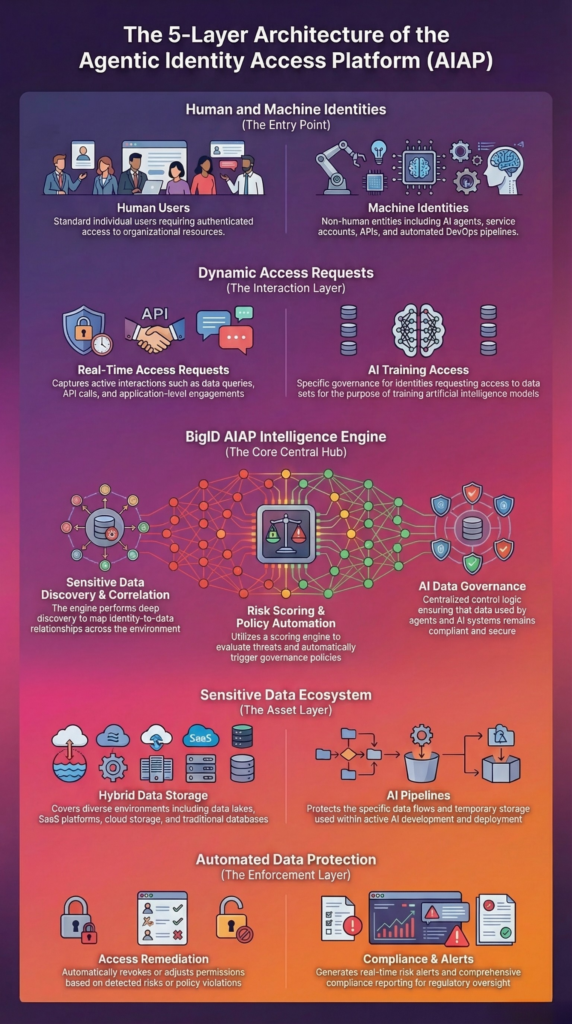
An Agentic Identity Access Platform (AIAP) is a security platform that governs how human users, machine identities, and AI agents access sensitive data across enterprise environments.
AIAP platforms combine:
This architecture allows organizations to continuously monitor identity access to sensitive data and automatically reduce exposure caused by excessive permissions, AI agents, and machine identities.
An Agentic Identity Access Platform (AIAP) governs how human users, machine identities, and AI agents access sensitive data across enterprise environments. It connects identity governance with data intelligence to automatically detect and reduce risky data access.
Unlike traditional identity systems, AIAP focuses on data-aware identity governance. The platform understands what data exists, how sensitive that data is, and which identities attempt to interact with it.
An AIAP platform continuously answers four critical questions:
- Who or what requests access?
- What sensitive data exists in that environment?
- Should that identity receive access based on risk and context?
- What actions should occur automatically to reduce risk?
This approach introduces agentic enforcement, where intelligent automation evaluates identity behavior and takes action immediately.
Organizations gain the ability to:
- Detect risky access across structured and unstructured data
- Govern machine and AI identities alongside human users
- Automatically remediate excessive permissions
- Control how AI systems interact with sensitive data
- Maintain compliance across global privacy regulations
In short, AIAP connects identity governance with real-time data intelligence.
Why Identity Security Must Evolve for AI
AI changes the identity landscape in three major ways.
1. Machine Identities Outnumber Humans
Automation pipelines, AI models, APIs, and service accounts now represent the fastest growing identity type in the enterprise.
Many organizations operate with 10 to 50 machine identities for every human user. Most traditional IAM tools never track these identities correctly.
2. AI Agents Act Autonomously
AI systems now perform tasks that once required human approval. These systems access databases, generate insights, and interact with sensitive records.
Without strict governance, these agents can:
- Access regulated data
- Expose personal information
- Train models on restricted datasets
- Amplify insider risk
3. Data Sprawl Expands Identity Risk
Modern organizations store sensitive data across:
- Multi-cloud environments
- SaaS platforms
- Data lakes and warehouses
- Collaboration systems
- AI pipelines
Identity tools that ignore data context cannot enforce safe access.
This shift drives the emergence of agentic identity governance.
AIAP vs Traditional IAM vs Access Intelligence
| Capability | IAM | Access Intelligence | AIAP |
|---|---|---|---|
| Authentication | ✓ | ✓ | ✓ |
| Sensitive Data Awareness | ✗ | Limited | ✓ |
| Machine Identity Governance | Limited | Partial | ✓ |
| AI Data Access Controls | ✗ | ✗ | ✓ |
| Automated Risk Remediation | Limited | Partial | ✓ |
Security leaders often ask how AIAP differs from existing identity tools. The distinction centers on data context and autonomous enforcement.
Traditional IAM
IAM focuses on authentication and basic authorization.
Capabilities include:
- User provisioning
- Authentication and SSO
- Role-based access control
- Directory services
Limitations:
- No awareness of sensitive data
- Weak visibility into machine identities
- Limited risk analysis
- Heavy manual administration
IAM answers who logs in, but not what data they access.
Access Intelligence Platforms
Access intelligence solutions analyze identity permissions and behavior.
Capabilities include:
- Permission analytics
- Risk scoring
- Access review automation
- Role optimization
Limitations:
- Limited integration with data discovery
- Weak control over AI and machine identities
- Minimal enforcement automation
Access intelligence identifies risk but rarely controls the underlying data exposure.
Agentic Identity Access Platforms (AIAP)
Agentic Identity Access Platforms represent the next evolution of identity security, combining identity governance, sensitive data intelligence, and automated risk remediation.
Core capabilities include:
- Sensitive data discovery and classification
- Identity-to-data mapping
- Machine and AI identity governance
- Automated access remediation
- AI data risk controls
- Real-time risk scoring
- Policy enforcement across cloud, SaaS, and data platforms
AIAP answers the question that modern security demands:
Which identities interact with sensitive data and what should happen next?
BigID pioneered the data-first approach to identity governance by connecting sensitive data discovery with access intelligence and AI risk management.
Key Use Cases for Agentic Identity Access
Security and privacy leaders face growing pressure from regulators, AI risk, and data breaches. AIAP delivers immediate value across several high-impact use cases.
1. Prevent AI Systems from Accessing Sensitive Data
Organizations increasingly deploy AI copilots and machine learning systems across business workflows.
Without proper governance, these systems can ingest:
- Personal data
- Financial records
- Health information
- Intellectual property
BigID identifies sensitive datasets and enforces policies that control how AI models interact with them.
Security teams gain full visibility and control over AI training and inference data access.
2. Eliminate Toxic Data Access
Many organizations operate with massive permission sprawl.
Employees and service accounts accumulate access across years of role changes.
BigID connects identity data with sensitive data discovery to detect:
- Excessive permissions
- Stale accounts
- High-risk data access
Automated remediation removes unnecessary access and reduces insider risk.
3. Govern Machine and Service Identities
Machine identities represent one of the largest identity attack surfaces.
Examples include:
- API tokens
- Service accounts
- DevOps pipelines
- AI agents
- Automation scripts
BigID identifies where these identities access sensitive data and enforces strict policies to reduce exposure.
Security teams gain control over non-human identities that traditional IAM overlooks.
4. Automate Privacy Compliance
Global regulations demand strict control over personal data access.
Examples include:
BigID maps identities to regulated data automatically. Privacy teams gain visibility into who accesses personal data and why.
Organizations reduce compliance risk without endless manual audits.
How BigID Powers Agentic Identity Access
BigID connects identity governance with deep data intelligence across the enterprise.
Security teams gain a unified platform that discovers sensitive data, maps identity access, and enforces protection policies.
Key capabilities include:
Sensitive Data Discovery at Scale
BigID scans structured and unstructured data across cloud, SaaS, databases, and data lakes.
Teams gain visibility into:
- PII
- PHI
- Financial data
- Intellectual property
- AI training datasets
Identity-to-Data Intelligence
BigID correlates identities with the sensitive data they access.
Security leaders see:
- Which identities access critical data
- Which permissions introduce risk
- Which data assets remain overexposed
Autonomous Risk Reduction
BigID automatically detects and reduces risky permissions.
Teams can:
- Remove excessive access
- Enforce least privilege
- Alert on suspicious behavior
- Govern machine identities
AI Data Security
BigID helps organizations control which datasets power AI models.
Security teams prevent:
- Data leakage
- Sensitive training data exposure
- Unauthorized model access
This approach protects both data and AI systems.
The Identity Landscape in 2026 and Beyond
The next phase of identity security will revolve around data-aware identity governance and AI risk control.
Several trends will shape the landscape.
Explosion of AI Agents
Organizations will deploy thousands of AI copilots and automated workflows. Each system will require strict identity and data controls.
Machine Identity Dominance
Machine identities will outnumber human users by orders of magnitude. Security teams will require automated identity governance.
Data-Centric Security Models
Security leaders will prioritize platforms that understand data sensitivity and context. Identity decisions will increasingly depend on data classification.
Autonomous Security Operations
AI-powered platforms will continuously evaluate access risk and take action without manual intervention.
Organizations that adopt AIAP early will gain a critical advantage. They will control identity risk across data, automation, and AI.
Why Security Leaders Must Act Now
AI adoption moves faster than most governance programs.
Organizations already deploy AI copilots, automated pipelines, and machine learning models across production environments. These systems interact with sensitive data every day.
Without agentic identity governance, companies face several risks:
- AI-driven data leakage
- Uncontrolled machine identities
- Excessive permissions
- Compliance failures
Insider threats amplified by automation
Security leaders cannot rely on legacy IAM systems to solve these challenges.
They need a platform that connects identity intelligence with data security.
BigID delivers that capability today.
FAQs: Agentic Identity Access Platforms (AIAP)
What is Agentic Identity Access?
Agentic identity access describes the governance of human identities, machine identities, and AI agents interacting with sensitive data. It ensures organizations can detect risky access, enforce least privilege, and prevent AI systems from accessing restricted datasets.
Agentic identity access platforms use data intelligence, identity analytics, and automated enforcement to reduce identity-driven data exposure.
What is an Agentic Identity Access Platform (AIAP)?
An Agentic Identity Access Platform governs how human users, machine identities, and AI agents interact with sensitive data. It connects identity governance with data discovery, risk analysis, and automated policy enforcement.
Why do organizations need AIAP?
AI systems and machine identities increasingly access enterprise data. Traditional IAM tools cannot evaluate data sensitivity or control AI data usage. AIAP provides data-aware identity governance.
How does AIAP differ from IAM?
IAM manages authentication and user provisioning. AIAP governs how identities interact with sensitive data across cloud platforms, data systems, and AI pipelines.
How does AIAP improve data security?
AIAP detects excessive permissions, identifies risky identity behavior, and automatically reduces access to sensitive data. Organizations gain continuous risk reduction.
How does BigID support Agentic Identity Access?
BigID discovers sensitive data across the enterprise, maps identity access to that data, and enforces automated policies that reduce exposure and protect AI systems.
What industries benefit most from AIAP?
Industries with large volumes of regulated data see immediate value:
- Financial services
- Healthcare
- Technology
- Government
- Retail
- Telecommunications
Final Thought
AI changes the identity equation. Autonomous agents now interact with sensitive data at machine speed.
Security leaders must respond with data-aware, automated identity governance.
Agentic Identity Access Platforms represent the next evolution of identity security.
Organizations that connect identity intelligence with data protection will control risk, protect privacy, and move faster with AI.
Organizations that delay will struggle to keep their most sensitive data under control.
The shift has already begun.
See how BigID helps you control identity-driven data risk across humans, machines, and AI agents. Schedule a 1:1 with our security experts today!
Author