

UK GDPR places strict obligations on organizations to understand where personal data exists, how it flows across systems, and how it is protected.
However, many enterprises struggle to answer basic questions:
- Where does sensitive data exist across our environment?
- Who can access that data?
- Which repositories create the highest regulatory risk?
These questions become difficult to answer in modern data environments filled with cloud storage, SaaS applications, collaboration tools, and AI pipelines.
Data Security Posture Management (DSPM) helps organizations solve this challenge.
DSPM gives security and privacy teams the visibility required to discover sensitive data, classify regulated information, and reduce exposure risk before incidents occur.
For UK enterprises navigating regulatory pressure and data growth, DSPM has quickly become a foundational capability.
At a Glance
• UK GDPR requires organizations to know where personal data exists and how it is protected.
• Many enterprises lack visibility into sensitive data across modern environments.
• DSPM helps discover, classify, and govern personal data at scale.
• Organizations strengthen compliance and reduce regulatory risk with continuous data visibility.
Best for: Privacy leaders, DPOs, and compliance teams.
Why UK GDPR Requires Data Visibility
UK GDPR focuses heavily on accountability and data protection principles.
Organizations must demonstrate that they understand how personal data flows across their systems.
Several GDPR principles require strong data visibility.
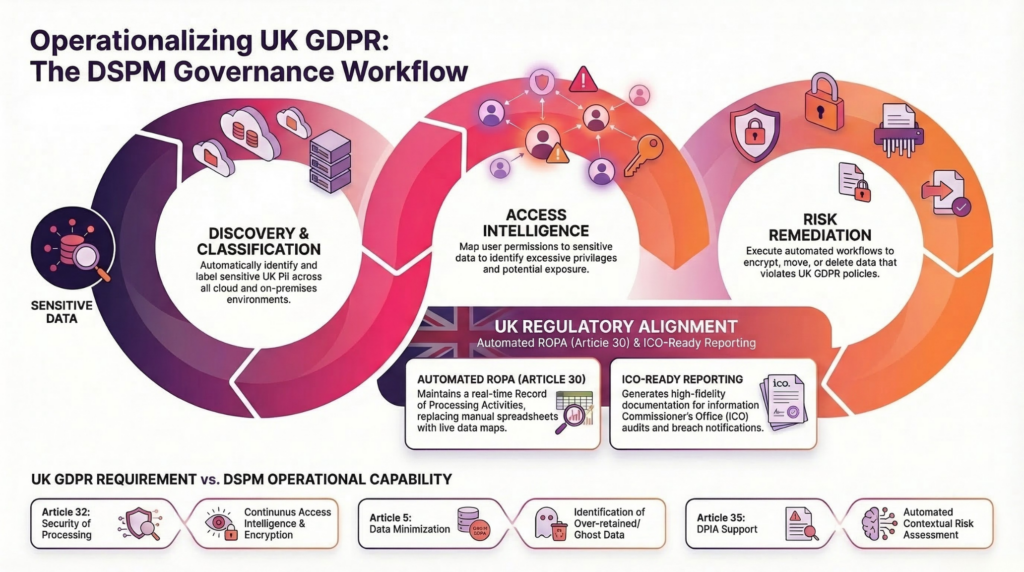
Data Minimization
Organizations must collect and retain only the data necessary for legitimate purposes.
DSPM helps identify:
- redundant data copies
- unnecessary personal data storage
- outdated sensitive data
Security teams can reduce risk by eliminating unnecessary data.
Storage Limitation
Personal data should not remain in systems longer than necessary.
DSPM helps organizations locate:
- legacy repositories containing personal data
- archived sensitive files
- outdated datasets stored in cloud environments
Organizations can enforce retention policies more effectively.
Security of Processing
Organizations must protect personal data from unauthorized access.
DSPM reveals where sensitive data resides and identifies who can access it.
Security teams can remove unnecessary permissions and reduce insider risk.
The Hidden Data Exposure Problem
UK enterprises often discover sensitive data in unexpected places.
Examples include:
- spreadsheets containing customer information stored in SharePoint
- archived documents containing personal data stored in cloud storage
- collaboration platforms containing confidential conversations
- AI datasets containing regulated information
Without discovery and classification, organizations cannot manage these risks.
DSPM helps identify these exposures quickly.
Real-World GDPR Use Cases for DSPM
Identifying Sensitive Data Across Cloud Platforms
Many organizations store regulated data in cloud environments such as AWS and Azure.
DSPM scans these environments to identify sensitive data automatically.
Security teams can then prioritize high-risk repositories.
Detecting Excessive Data Access
One of the most common GDPR risks involves excessive access to sensitive data.
DSPM identifies:
- over-permissioned folders
- shared data repositories
- stale user permissions
Organizations can restrict access before a breach occurs.
Accelerating Data Subject Request Response
GDPR requires organizations to respond to data subject access requests.
Organizations must quickly locate personal data across multiple systems.
DSPM simplifies this process by mapping where sensitive data exists.
Frequently Asked Questions About DSPM and UK GDPR Compliance
1. What is DSPM and how does it support UK GDPR compliance?
DSPM helps organizations discover personal data, classify regulated information, analyze access risk, and reduce exposure. This supports key UK GDPR requirements such as accountability, data minimization, and security of processing.
2. Why is data visibility critical for UK GDPR?
UK GDPR requires organizations to understand where personal data exists, how it flows, and who can access it. Without visibility, organizations cannot enforce policies, respond to requests, or demonstrate compliance.
3. How does DSPM help with data minimization?
DSPM identifies redundant, outdated, and unnecessary personal data across systems. Security and privacy teams can remove or reduce excess data, which helps meet GDPR data minimization requirements.
4. How does DSPM improve access control for personal data?
DSPM analyzes who can access sensitive data and identifies excessive or unnecessary permissions. Organizations can then restrict access and reduce insider risk, which supports GDPR security requirements.
5. Can DSPM help with data subject access requests (DSARs)?
Yes. DSPM maps where personal data exists across systems, which allows organizations to locate and retrieve data quickly. This improves response times and accuracy for DSARs.
6. What types of personal data can DSPM discover?
DSPM discovers structured and unstructured personal data, including customer records, employee data, financial information, and regulated data stored across cloud, SaaS, and on-prem environments.
7. How does DSPM reduce data breach risk?
DSPM identifies high-risk exposures such as unclassified sensitive data, over-permissioned access, and unsecured repositories. Security teams can take action before these risks lead to a breach.
8. Why do traditional security tools fall short for GDPR compliance?
Traditional tools focus on infrastructure, networks, and endpoints. GDPR focuses on data. These tools do not provide visibility into where personal data exists or who can access it, which creates compliance gaps.
9. How does DSPM help manage data across cloud and SaaS environments?
DSPM scans cloud platforms and SaaS applications to discover and classify personal data. It provides consistent visibility across environments, which helps organizations manage risk and enforce governance.
10. How does DSPM support AI-related data compliance risks?
DSPM helps organizations identify and govern sensitive data before it enters AI systems. This reduces the risk of exposing personal data in AI training datasets or outputs, which is critical for maintaining compliance.
Why DSPM Supports Stronger GDPR Compliance
Traditional security tools do not focus on data itself.
They monitor infrastructure, networks, and endpoints.
However, GDPR focuses on data governance.
DSPM bridges that gap by helping organizations:
- discover personal data
- classify regulated information
- analyze access risk
- reduce exposure
This allows organizations to demonstrate strong data protection practices.
Preparing for the Future of Data Regulation
Regulators increasingly expect organizations to understand their data environments in detail.
Data visibility will become even more important as AI adoption grows.
AI systems often ingest enterprise data without strong governance.
DSPM helps organizations govern sensitive data before it enters AI pipelines.
For UK enterprises, this capability will become increasingly critical.
See How BigID Helps Discover and Govern Sensitive Data.
Author