

Artificial intelligence already drives critical decisions in financial services. Banks use AI to detect fraud, score credit, automate compliance, and personalize customer experiences. A new phase now emerges: agentic AI in financial services.
Agentic AI systems do more than analyze data or generate content. These systems plan, decide, and act across financial workflows. They operate as autonomous digital workers that interact with enterprise systems, data pipelines, and other AI agents.
For financial institutions, the opportunity is enormous. So is the risk. Autonomous decision systems introduce new governance, compliance, and operational challenges that regulators increasingly scrutinize.
The institutions that lead this next phase will not simply deploy better models. They will build trusted AI ecosystems grounded in governed data.
What Is AI in Financial Services Today?
AI already plays a central role in financial operations. Institutions deploy machine learning and analytics across multiple domains.
Common use cases include:
- Fraud detection and transaction monitoring
- Anti-money laundering (AML) investigations
- Credit scoring and underwriting
- Algorithmic trading
- Customer service automation
- Risk modeling and stress testing
Most current AI systems operate in predictive or analytical modes. They analyze historical data and generate insights or recommendations.
Agentic AI expands this model.
Instead of stopping at predictions, AI systems can now execute actions autonomously across enterprise workflows.
What Is Agentic AI?
| Capability | Traditional AI | Agentic AI |
|---|---|---|
| Function | Prediction and analysis | Autonomous decision-making |
| Workflow Integration | Limited | End-to-end orchestration |
| Human Oversight | High | Human-in-the-loop |
| Adaptability | Static models | Continuous learning |
Agentic AI in financial services refers to autonomous AI systems that plan, make decisions, and execute tasks across financial workflows such as fraud detection, compliance monitoring, and credit risk analysis.
These systems combine multiple components:
- AI models
- workflow orchestration
- memory and contextual awareness
- tool access through APIs
- continuous learning loops
Agentic systems operate through a recurring cycle:
Observe → Reason → Act → Learn
Example in banking:
- Monitor real-time transaction streams
- Identify suspicious patterns
- Launch investigation workflows
- escalate high-risk cases
- generate regulatory reports
Unlike static automation, agentic AI adapts continuously as conditions change.
Research shows multi-agent AI systems can coordinate workflows such as fraud detection and compliance monitoring, though most financial institutions still operate in pilot or early deployment stages.
The Current State of Agentic AI in Financial Services
Most financial institutions remain in early experimentation stages. Banks continue to test agentic AI across fraud detection, customer service automation, and compliance workflows. Large-scale deployments remain limited as organizations address governance, security, and regulatory requirements.
How Agentic AI Systems Work in Financial Institutions
Agentic AI systems operate across multiple layers of financial infrastructure. These systems combine data access, autonomous reasoning, and workflow execution to complete complex tasks across banking operations.
Understanding this architecture helps explain both the power and governance requirements of agentic AI.
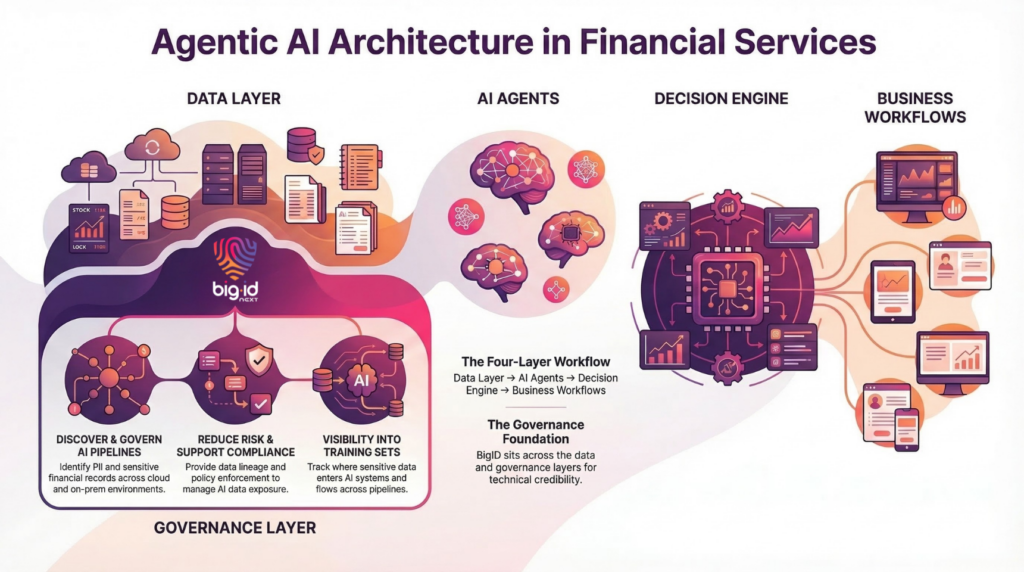
Data Layer
Financial institutions generate massive volumes of data across systems including transactions, customer records, payment platforms, trading systems, and compliance tools.
This data fuels AI decision-making. Without visibility into where sensitive financial data exists, organizations cannot safely deploy autonomous systems.
AI Agent Layer
Specialized AI agents perform specific tasks across financial workflows.
Examples include:
- fraud detection agents
- credit risk analysis agents
- compliance monitoring agents
- customer service agents
These agents analyze data, evaluate outcomes, and coordinate actions across enterprise systems.
Governance and Data Intelligence Layer
Financial institutions must monitor how AI systems access and use sensitive data.
Governance ensures organizations can:
- identify regulated data
- track datasets used for AI models
- enforce data access policies
- demonstrate regulatory compliance
Platforms like BigID provide the intelligence layer that connects data governance, privacy, security, and AI risk management.
Why Agentic AI Matters for Financial Institutions
Financial services operates in a high-velocity environment where decisions must occur instantly and accurately.
Agentic AI supports three major capabilities.
Operational Scale
Large banks run thousands of operational workflows.
Examples include:
- customer onboarding
- fraud investigations
- regulatory reporting
- compliance monitoring
Agentic AI automates many of these workflows.
Consulting research suggests AI-driven automation could transform banking operations that historically required large operational teams.
Real-Time Decision Making
Financial markets and payment systems operate continuously.
Agentic AI enables:
- dynamic credit risk assessments
- real-time fraud prevention
- automated trading strategies
- adaptive portfolio management
Decisions that once took hours or days now occur instantly.
Continuous Learning
Traditional automation relies on static rules.
Agentic systems learn from:
- new transactions
- regulatory updates
- behavioral patterns
This adaptability makes them powerful but also introduces governance challenges.
Real-World Use Cases for Agentic AI in Financial Services
Several emerging deployments demonstrate how agentic AI may transform core banking workflows.
Fraud Detection and Investigation
AI agents monitor transaction streams and detect suspicious patterns.
Workflow example:
- anomaly detection
- automated investigation
- case prioritization
- regulatory reporting
This automation reduces investigation time while improving detection accuracy.
Autonomous Credit Risk Analysis
Multi-agent systems analyze borrower risk in real time.
Inputs include:
- credit histories
- behavioral transaction data
- open banking signals
- macroeconomic indicators
These systems can adapt risk scoring models as market conditions change.
Intelligent Customer Operations
Financial institutions increasingly use AI agents to coordinate customer workflows.
Examples include:
- automated loan application processing
- document verification
- account onboarding
- personalized financial recommendations
Agents coordinate across internal systems to complete these processes faster.
The Regulatory Landscape for AI in Financial Services
Financial services remains one of the most regulated sectors adopting AI.
Autonomous AI systems raise significant regulatory questions.
EU AI Act
The EU AI Act classifies several financial AI systems as high-risk applications, including creditworthiness assessment.
Requirements include:
- risk management frameworks
- strong data governance
- human oversight
- model transparency
- auditability
Noncompliance can lead to major financial penalties.
Model Risk Governance
US regulators require financial institutions to manage AI models under strict governance frameworks.
Examples include:
These frameworks require:
- model validation
- documentation
- data lineage
- continuous monitoring
Autonomous AI systems complicate these requirements because they evolve over time.
Data Privacy Regulations
AI systems often rely on sensitive financial and personal data.
Relevant regulations include:
Institutions must demonstrate how AI systems access and use regulated data.
The Operational Challenges Banks Must Solve
Agentic AI introduces new challenges that many organizations underestimate.
Data Fragmentation
Large financial institutions operate across hundreds of data systems.
Without unified visibility, AI agents may operate on incomplete or inconsistent information.
Model Drift and Decision Risk
Autonomous systems evolve continuously.
Organizations must monitor:
- model accuracy
- bias
- unexpected behaviors
- decision quality
Third-Party AI Risk
Many institutions rely on external AI platforms or APIs.
This introduces additional concerns:
- data exposure
- vendor risk
- regulatory accountability
Explainability and Auditability
Financial institutions must explain automated decisions to regulators.
This requires clear documentation of:
- data sources
- model inputs
- decision logic
- system behavior over time
The Hidden Risk of Agentic AI: Unknown Data
Many organizations focus heavily on AI models.
The real risk often sits underneath those models.
Enterprise data environments frequently contain:
- sensitive personal data
- outdated records
- duplicate datasets
- unclassified regulated data
If AI systems access these datasets without governance, institutions risk:
- incorrect credit decisions
- privacy violations
- regulatory penalties
- reputational damage
Trusted AI requires trusted data foundations.
A Practical Framework for Agentic AI Adoption in Financial Services
Financial institutions should adopt a structured approach to implementing agentic AI.
Step 1: Map Enterprise Data
Organizations must identify where sensitive and regulated data exists.
This includes:
- customer data
- financial records
- AI training datasets
- regulated information
Data discovery forms the foundation of responsible AI.
Step 2: Establish AI Governance Policies
Institutions should define policies covering:
- data usage
- model training controls
- access permissions
- risk thresholds
Step 3: Implement Human Oversight
Certain financial decisions require human validation.
Examples include:
- loan approvals
- high-risk fraud cases
- regulatory reporting
Human oversight ensures accountability.
Step 4: Monitor AI Systems Continuously
Organizations must monitor AI systems for:
- data drift
- model bias
- anomalous decisions
- operational risk
Continuous monitoring supports regulatory compliance.
Organizational Impact: AI and the Financial Workforce
Agentic AI will reshape financial operations rather than eliminate workers.
The future workforce will combine human expertise with autonomous systems.
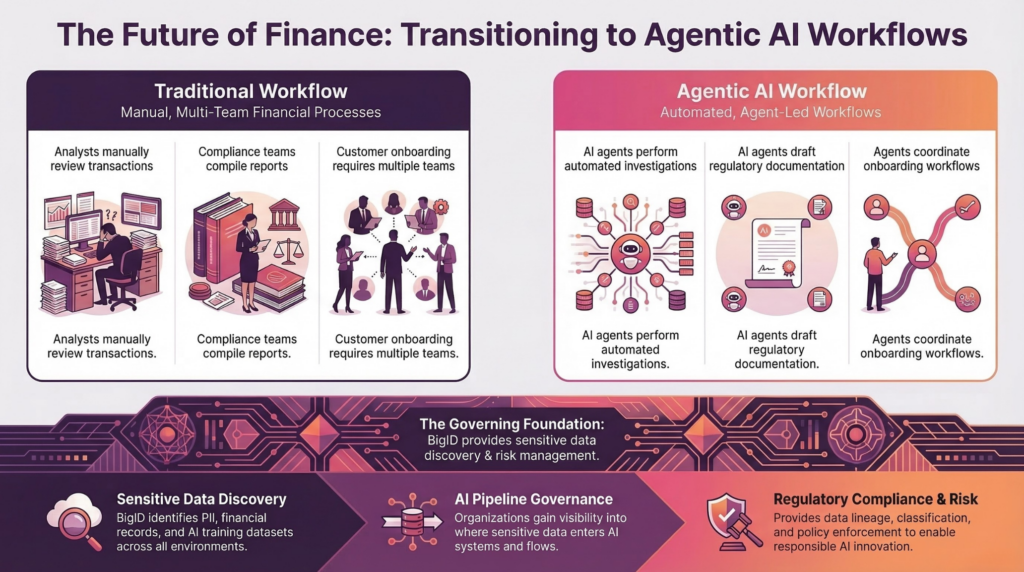
Human teams will supervise, validate, and govern AI-driven operations.
Why BigID Is Built for the Agentic AI Era
Agentic AI increases the need for data visibility and governance.
BigID provides the intelligence layer that connects data, privacy, security, and AI governance.
Financial institutions use BigID to:
Discover Sensitive Data
BigID identifies:
- PII
- financial records
- regulated data
- AI training datasets
Across cloud, SaaS, and on-prem environments.
Govern AI Data Pipelines
Organizations gain visibility into:
- which datasets train AI models
- where sensitive data enters AI systems
- how data flows across AI pipelines
Support Regulatory Compliance
BigID helps institutions meet regulatory obligations by providing:
- data lineage
- classification
- policy enforcement
- auditability
Reduce AI Risk
BigID enables organizations to:
- monitor sensitive data exposure
- control data access
- manage AI data risk across environments
This foundation supports responsible AI innovation in financial services.
Agentic AI in Financial Services: FAQs
What is agentic AI in financial services?
Agentic AI refers to autonomous AI systems that can plan, make decisions, and execute tasks across financial workflows such as fraud detection, compliance monitoring, and credit risk analysis.
How is agentic AI different from generative AI?
Generative AI produces content such as text, images, or code.
Agentic AI takes actions across enterprise systems to complete tasks and achieve defined goals.
What are the biggest risks of agentic AI in banking?
Key risks include:
- biased decisions
- privacy violations
- lack of explainability
- data governance gaps
- regulatory noncompliance
Is agentic AI already used in financial services?
Yes. Financial institutions already test agentic AI in fraud detection, compliance automation, and customer operations. Most deployments remain early stage due to governance and regulatory considerations.
Strategic Outlook: The Data Layer Will Define AI Leadership
Financial services will not compete solely on AI models.
The competitive advantage will come from how well institutions govern the data that powers those models.
Agentic AI will operate across sensitive financial data, regulatory processes, and customer decisions. Institutions that lack visibility into their data cannot safely deploy autonomous systems.
The organizations that lead this transformation will treat data intelligence as core infrastructure. They will map sensitive data across environments, govern how AI systems use that data, and prove compliance to regulators with clear lineage and oversight.
BigID enables this foundation. By connecting the dots across data and AI, the platform gives financial institutions the confidence to deploy autonomous systems while maintaining trust, compliance, and control.
Author