Skip to content

Home ยป Data Coverage ยป Cloudera

Cloudera Data Discovery and Classification

Complete Visibility Across Cloudera Data Lake Environments

Cloudera environments store vast volumes of structured, semi-structured, and unstructured data across distributed systems. BigID delivers content-based data discovery and sensitive data classification across Cloudera so organizations can accurately identify regulated, confidential, and high-risk data at scale.

How BigID Delivers Data Discovery Across Cloudera

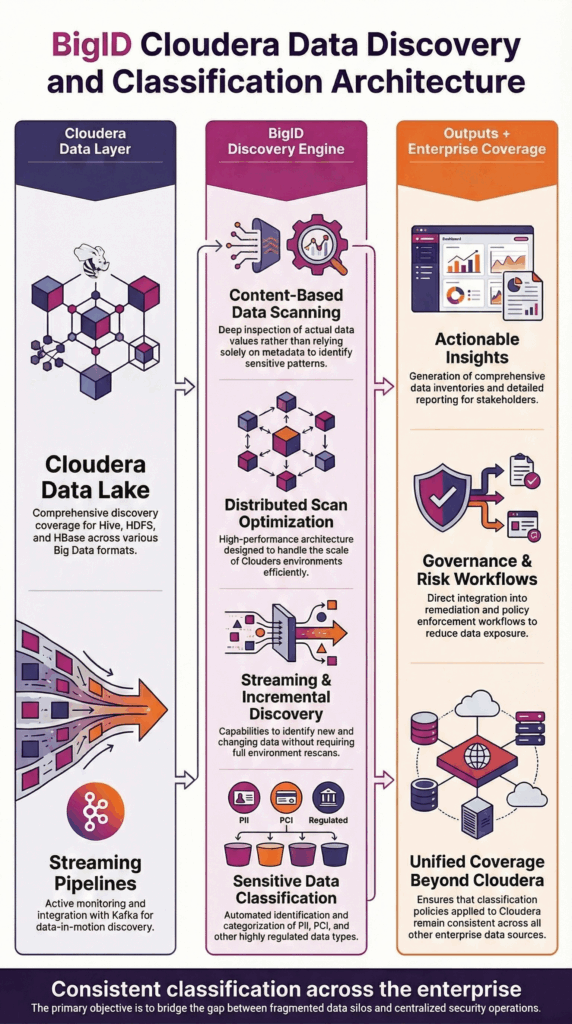
BigID connects securely to Cloudera environments to perform content-based data discovery across Hive, HDFS, HBase, and streaming pipelines. It scans actual data values across structured, semi-structured, and unstructured datasets to accurately identify sensitive and regulated information.

BigID supports distributed processing to align with large-scale Cloudera deployments, enabling scalable discovery across data lake environments while maintaining operational performance.

Discovery results integrate with enterprise classification policies, governance workflows, and reporting frameworks to deliver actionable visibility across the broader data ecosystem.

This architecture ensures precise, enterprise-scale Cloudera data discovery without disrupting production workloads.

The BigID Advantage for Cloudera

Deep Data-Level Discovery Across Distributed Storage

BigID scans across:

  • Hive tables
  • HDFS file systems
  • HBase data stores
  • Parquet and Big Data file formats
  • Structured, semi-structured, and unstructured datasets

BigID inspects actual data content, not just metadata catalogs, to identify sensitive information across distributed data lake environments.

Scalable Processing with Native Compute Alignment

Cloudera environments require performance-aware scanning.

BigID supports distributed scanning and optional alignment with native compute frameworks, including MapReduce, to leverage data locality and reduce unnecessary data movement.

Organizations can:

  • Schedule scans during preferred windows
  • Configure performance thresholds
  • Optimize for availability and operational KPIs

The result is scalable discovery across petabyte-scale environments.

Streaming and Incremental Data Visibility

Data lakes constantly change.

BigID supports scanning of streaming pipelines, including Kafka and Confluent integrations, to monitor data entering or leaving Hadoop and Cloudera environments.

Organizations can:

  • Scan only new or modified data
  • Monitor streaming data ingestion
  • Maintain continuous classification without full re-scans

This ensures data discovery remains current in dynamic environments.

High-Confidence Classification Across Big Data

BigID applies advanced classification and correlation techniques to identify:

  • Personal data under global privacy regulations
  • Financial and payment information
  • Employee and HR data
  • Regulated industry data
  • Proprietary and sensitive enterprise data

Classification extends across distributed file systems and large-scale datasets to deliver consistent enterprise coverage.

Technical Advantages

Content-Based Discovery at Scale

Scans actual data values across Hive, HDFS, HBase, and distributed storage.

Distributed Performance Optimization

Supports MapReduce alignment and scalable scanning across large environments.

Streaming Data Coverage

Monitors Kafka and Confluent pipelines for incremental discovery.

Unified Reporting and Governance

Delivers inventory reporting, policy alignment, and audit-ready documentation.

Cloudera Data Discovery and Classification FAQs

Does BigID support data discovery across all major Cloudera interfaces?
Yes. BigID supports discovery across Hive, HDFS, and HBase, and it can scan common Big Data file formats such as Parquet.
Can BigID align scanning with native compute in Cloudera?
BigID supports distributed scanning and can optionally align with native processing frameworks like MapReduce to leverage data locality and support large-scale environments.
How does BigID handle streaming or incremental data in Cloudera?
BigID integrates with Kafka and Confluent pipelines to monitor data entering or leaving Cloudera environments and supports change-focused scanning to keep discovery current without full rescans.
What types of sensitive data can BigID identify in Cloudera?
BigID identifies regulated personal data, financial and payment information, HR records, industry-regulated categories, proprietary business data, and custom-defined sensitive elements aligned to your policies.
How do teams use BigIDโ€™s Cloudera discovery results?
Teams use BigID to generate sensitive data inventories, create classification summaries, and export documentation that supports governance reviews, audits, and policy validation efforts.

Get Complete Visibility Across Cloudera

Cloudera environments concentrate massive volumes of high-value data. BigID ensures sensitive data does not become invisible inside distributed systems.

Industry Leadership