
APAC organizations operate across one of the most complex privacy landscapes in the world.
Regulations continue to evolve across countries, each with distinct requirements for how organizations collect, store, process, and transfer data. At the same time, enterprises scale cloud adoption, expand SaaS usage, and invest heavily in AI.
Data moves across borders faster than compliance teams can track or control.
This creates a critical challenge:
Privacy leaders must understand where personal data exists, how it moves across jurisdictions, and who can access it.
Data Security Posture Management (DSPM) gives organizations the visibility and control required to meet that challenge.
At a Glance
• APAC privacy compliance varies widely across jurisdictions, which makes governance harder to scale.
• Cross-border data movement and localization requirements increase regulatory and operational risk.
• DSPM helps teams discover personal data, classify it, govern access, and track movement across regions.
• Privacy leaders need continuous visibility into sensitive data to prove compliance with confidence.
Best for: CPOs, privacy leaders, and compliance teams managing data across APAC.
The Fragmented Reality of APAC Data Privacy Regulations
APAC does not operate under a single regulatory framework.
Instead, organizations must navigate a patchwork of national laws, each with unique expectations for data governance and privacy.
Key Regulations Across APAC
Singapore PDPA
Requires organizations to obtain consent, protect personal data, and limit use to defined purposes.
Australia Privacy Act
Focuses on transparency, data handling practices, and accountability for personal information.
Japan APPI
Mandates strict controls on personal data use and cross-border transfers.
China PIPL
Imposes strict requirements on data processing, localization, and cross-border transfers.
India DPDP Act
Introduces consent-driven data processing and strong obligations for data protection and accountability.
Each regulation introduces different requirements for data:
No single control model covers every APAC jurisdiction.
Privacy teams need a unified way to manage data across fragmented regulations.
The Cross-Border Data Governance Challenge
APAC enterprises rarely operate within a single country.
Teams move data across:
- regional cloud environments
- shared SaaS platforms
- global analytics systems
- AI pipelines and data lakes
This creates immediate compliance risk.
Privacy teams must answer:
- Where does personal data reside across regions?
- Which datasets cross borders?
- Do transfers comply with local regulations?
- Who can access regulated data in each jurisdiction?
Without clear answers, organizations expose themselves to regulatory penalties and operational risk.
Data Localization and Sovereignty Pressures
Several APAC regulations impose strict controls on where data resides.
China PIPL and other regional laws introduce requirements such as:
- storing sensitive data within national borders
- restricting cross-border transfers
- enforcing localized governance controls
This creates direct conflict between global operations and local compliance.
-
- global data strategies
- regional compliance requirements
Organizations must balance:
- operational efficiency
- regulatory alignment
- data security
Visibility into data location and movement becomes essential.
Why Traditional Privacy Approaches Fall Short
Many organizations rely on:
- manual data mapping
- periodic audits
- legacy governance tools
These approaches cannot keep up with:
- unstructured data growth
- real-time data movement
- AI-driven data usage
They fail to answer fundamental questions:
- What personal data exists across environments?
- Where does it live?
- Who can access it right now?
This creates gaps between policy and execution.
How DSPM Supports Privacy Compliance Across APAC
The following model shows how DSPM operationalizes privacy compliance across APAC:
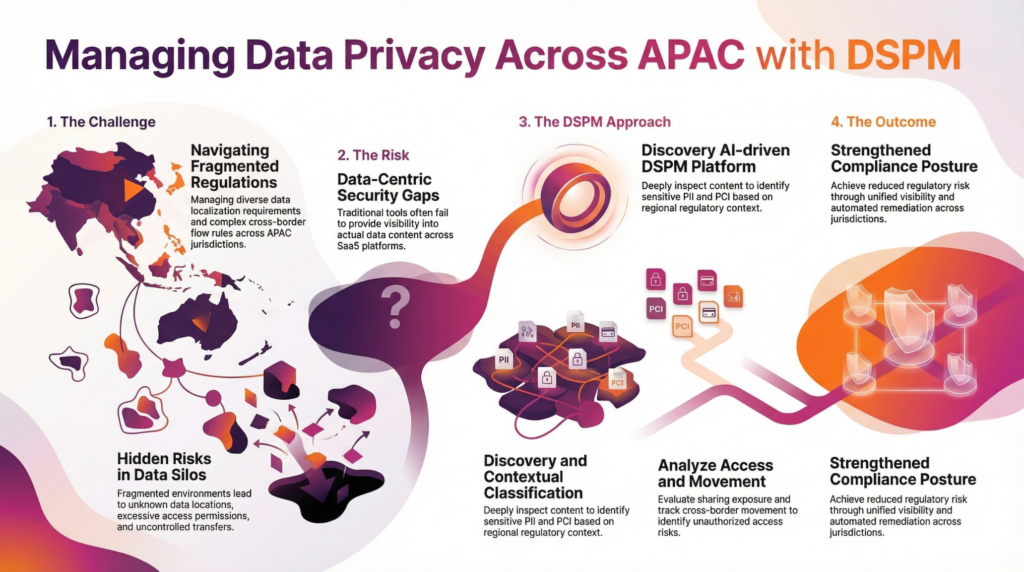
DSPM turns privacy into continuous data intelligence.
It gives privacy and compliance teams the ability to operate with precision across fragmented environments.
BigID delivers the most advanced DSPM by combining deep data discovery, AI-driven classification, and actionable remediation across all data environments.
1. Discover Personal Data Across All Environments
DSPM scans:
- cloud platforms
- SaaS applications
- unstructured repositories
- on-prem systems
Teams gain a real-time view of where personal data exists across regions.
2. Classify Data Based on Regulatory Context
Not all data carries the same risk.
DSPM classifies data based on:
- personal data types
- regulated information
- jurisdiction-specific requirements
This allows organizations to align data classification with:
3. Understand and Govern Data Access
Privacy risk often stems from excessive access.
DSPM provides:
- visibility into who can access sensitive data
- identification of over-permissioned datasets
- insight into cross-border access patterns
Teams can enforce:
- least-privilege access
- role-based controls
- jurisdiction-specific restrictions
4. Track Data Movement Across Borders
DSPM helps organizations:
- identify where data resides
- understand how it flows across regions
- detect cross-border transfers
This enables privacy teams to:
- validate compliance with transfer requirements
- reduce unauthorized data movement
- enforce data sovereignty policies
5. Demonstrate Compliance with Confidence
Regulators expect proof, not intent.
DSPM provides:
- audit-ready data visibility
- clear mapping of data locations
- access intelligence and risk insights
Privacy leaders can:
- demonstrate accountability
- support regulatory reporting
- respond to audits with confidence
DSPM for Privacy Leaders: Turning Complexity Into Control
For CPOs and compliance leaders, the challenge goes beyond understanding regulation.
The real challenge lies in operationalizing it.
DSPM enables teams to:
- move from static policies to continuous visibility
- align data governance with regional regulations
- reduce exposure before it becomes a compliance issue
This transforms privacy from reactive reporting to proactive risk management.
Frequently Asked Questions About DSPM and APAC Privacy Regulations
1. What makes APAC data privacy compliance more complex than other regions?
APAC includes multiple countries with distinct regulations. Each law defines its own requirements for data handling, access control, and cross-border transfers, which creates operational complexity.
2. How does DSPM help with regulations like PIPL or PDPA?
DSPM discovers personal data, classifies it based on regulatory requirements, and provides visibility into access and movement. This allows organizations to align controls with each regulation.
3. Can DSPM track cross-border data transfers?
Yes. DSPM identifies where data resides and how it moves across regions. This helps organizations monitor and control cross-border data flows.
4. How does DSPM support data localization requirements?
DSPM shows where sensitive data exists and helps enforce policies that restrict data to specific regions or jurisdictions.
5. Does DSPM replace traditional privacy tools?
No. DSPM complements existing tools by providing deep visibility into data. It strengthens privacy programs by identifying risk and enabling action.
6. What types of data does DSPM discover?
DSPM discovers structured and unstructured data, including personal data, financial information, intellectual property, and regulated datasets.
7. How does DSPM help demonstrate compliance?
DSPM provides audit-ready insights into data location, classification, and access. This allows organizations to prove how they protect sensitive data.
8. Why is data visibility critical for compliance?
Organizations cannot enforce policies or meet regulatory requirements without knowing where data exists and who can access it.
Take Control of Privacy Across APAC
Privacy compliance in APAC demands more than policy. It demands continuous control over data.
It requires visibility, control, and continuous action across complex environments.
DSPM gives organizations the ability to:
- discover sensitive data
- understand access and movement
- align with regional regulations
- reduce compliance risk at scale
That is how modern enterprises protect data, meet regulatory expectations, and move forward with confidence.
See How BigID Helps You Discover, Control, and Reduce Sensitive Data Risk Across APAC.
Author