Agentic systems are quickly moving from experimentation to production. Autonomous agents now access enterprise data, trigger actions, and operate across cloud, SaaS, and unstructured environments—often without direct human involvement.
This evolution introduces a new governance challenge. Existing security and governance controls were designed for human users and relatively static applications. They assume stable roles, predictable access patterns, and infrequent change. Agentic systems do not behave this way. They operate continuously, span systems, and interact with sensitive data in ways that are difficult to anticipate in advance.
To govern agentic environments safely and at scale, organizations need to shift their approach. The answer is not more point controls or manual oversight, but a declarative governance framework—one that defines acceptable behavior up front, continuously observes activity against those expectations, and intervenes when usage falls outside policy.
BigID provides the data-centric foundation required to secure and govern AI-driven systems by focusing on what matters most: the data itself, who or what can access it, and how it is used in practice.
From Static Controls to Declarative Governance
Declarative governance starts by defining intent rather than hard-coding permissions.
Instead of relying on brittle rules or one-time approvals, organizations declare:
- What data is sensitive
- Who or what is allowed to access it
- Under which conditions that access is acceptable
- What actions should occur when usage deviates from policy
This model is especially critical in environments with non-human identities, service accounts, and autonomous workflows. Governance must be continuous, contextual, and adaptive—not manual or reactive.
BigID enables this shift by unifying data discovery and classification with access visibility and activity monitoring, allowing policies to be defined at the data level and enforced consistently across environments.
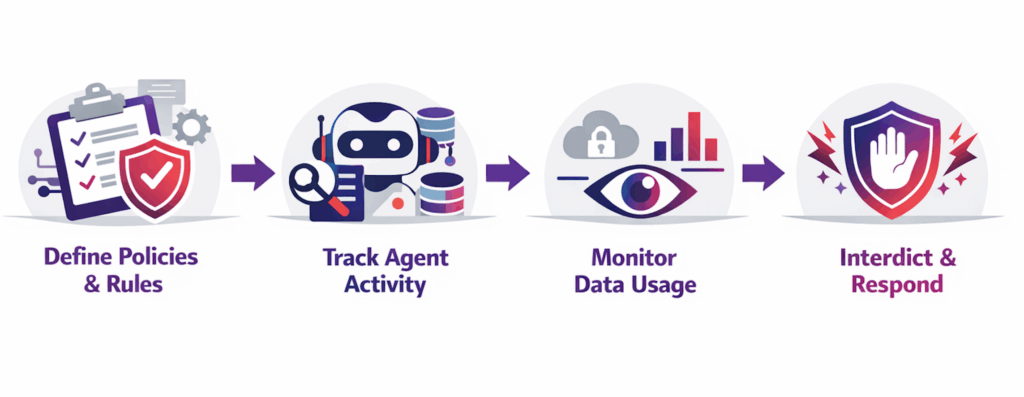
Defining Policies and Rules for Acceptable Behavior
Effective governance begins with clear definitions of acceptable behavior.
In agentic environments, policies can no longer be limited to role-based access alone. They must account for:
- Data sensitivity and classification
- Purpose and context of access
- Identity type (human and non-human)
- Scope, frequency, and patterns of use
BigID enables organizations to define data-centric policies that describe how sensitive data should be accessed and used, based on actual data context rather than assumptions. These policies can specify:
- Which agents or services may access regulated or high-risk data
- Where sensitive data is permitted to flow
- What constitutes over-privilege or over-exposure
- When access should be restricted or remediated
Because these policies are grounded in continuously updated data intelligence, they remain aligned with how data exists and evolves across the enterprise.
Tracking Agent Access and Interaction Activity
Knowing what an agent can access is not sufficient. Governance requires visibility into what agents actually do.
Agentic systems often operate across multiple platforms and data stores, making it difficult to understand access paths or assess impact when something goes wrong. Identity-only controls and fragmented logs create blind spots—particularly for non-human identities.
BigID provides unified visibility into agent access and interaction activity by correlating:
- Identity (human and non-human)
- Permissions and entitlements
- Data sensitivity and ownership
- Actual access and usage patterns
This allows security and governance teams to clearly see which agents are accessing which data across cloud storage, SaaS platforms, file shares, and data platforms—from a single, contextual view.
Monitoring Acceptable Data Usage in Context
Access alone does not determine risk. Usage does.
An agent may have legitimate access to sensitive data and still create risk by:
- Accessing data outside its intended purpose
- Moving or copying large volumes unexpectedly
- Propagating errors at scale
BigID’s Data Activity Monitoring focuses on understanding data usage in context. By correlating activity with data classification, permissions, ownership, and historical behavior, organizations can distinguish expected usage from behavior that warrants attention.
This enables teams to answer key governance questions:
- Is this data usage expected for this agent or service?
- Does the activity align with declared policy?
- What is the potential impact if the behavior continues?
Monitoring becomes an operational governance signal rather than a purely forensic exercise.
Altering and Interdicting Policy-Violating or Unusual Activity
Declarative governance only works if it can drive action.
In environments where agents operate continuously, relying on manual response is often impractical. Governance systems must be able to respond consistently and proportionately when usage falls outside policy.
BigID enables policy-driven intervention, including:
- Revoking or tightening access
- Quarantining sensitive data
- Enforcing data protection controls
- Triggering guided remediation workflows
Because these actions are tied directly to declared policies and data context, organizations can reduce risk without disrupting legitimate activity.
Why BigID Is the Foundation for Governing Agentic Systems
Most governance tools address only one part of the problem—identity, access, or monitoring. BigID brings these elements together through a data-centric approach.
With BigID, organizations can:
- Continuously discover and classify sensitive data
- Govern access across human and non-human identities
- Monitor data usage with context
- Apply consistent, policy-driven remediation
This unified foundation allows organizations to govern agentic systems with the same rigor applied to human access—while scaling to the complexity and pace of modern environments.
As agentic systems become embedded in core business processes, effective governance will depend on clear intent, continuous visibility, and the ability to act. BigID provides the platform to make that possible.
Want to learn more? Set up a 1:1 with one of our data and AI security experts today!
Author