Gestão da postura de segurança de dados (DSPM) O DSPM (Detective Security Postage Management) tornou-se rapidamente essencial para entender onde os dados sensíveis residem e como são expostos. Mas, à medida que a adoção do DSPM cresce, as organizações se deparam com uma dura realidade: A visibilidade por si só não reduz o risco —remediação faz.
Muitas equipes ainda dependem de sistemas de tickets como seu principal mecanismo de resolução de problemas. Os problemas são identificados, os tickets são abertos e os responsáveis são encaminhados aos respectivos encarregados. Em teoria, isso gera responsabilidade. Na prática, cria gargalos, sobrecarga de alertas e riscos não resolvidos.
Nos ambientes de dados atuais, impulsionados pela nuvem e pela IA, A emissão de tickets não é uma solução — e não basta operar na escala do DSPM.
O crescente desafio da remediação no DSPM
Os ambientes de dados modernos são dinâmicos, distribuídos e estão em constante mudança. Dados sensíveis abrangem armazenamento em nuvem, plataformas SaaS, data warehouses, compartilhamentos de arquivos e pipelines de IA. O acesso não se limita mais a usuários — inclui contas de serviço, fluxos de trabalho automatizados e Agentes de IA.
As ferramentas DSPM revelam esse risco em larga escala. Uma única avaliação Pode revelar milhares de objetos de dados expostos, configurações incorretas e caminhos de acesso excessivos. O verdadeiro desafio passa a ser decidir:
- O que realmente importa
- Quem deve consertar isso?
- Como isso deve ser remediado
- E se o risco foi realmente reduzido
Os fluxos de trabalho baseados em tickets nunca foram projetados para esse nível de complexidade.
Por que a emissão de bilhetes falha em grande escala?
Os sistemas de emissão de bilhetes ainda têm um papel a desempenhar, mas não podem servir de base para a remediação do DSPM.
Alertas em excesso, clareza insuficiente.
As equipes de segurança estão sobrecarregadas com descobertas em ferramentas de DSPM, DAM e segurança em nuvem. Frequentemente, os chamados carecem do contexto de dados necessário para entender a gravidade, o alcance ou o impacto subsequente, o que atrasa a triagem e a tomada de decisões.
A correção manual não consegue acompanhar o ritmo.
As correções feitas por humanos não são escaláveis para acompanhar o volume, a velocidade e a variedade dos riscos de dados modernos. Quando um chamado é resolvido, a exposição subjacente pode já ter mudado.
A propriedade fragmentada cria gargalos.
As equipes de segurança não conseguem solucionar todos os problemas sozinhas. Os proprietários dos dados e dos aplicativos geralmente são os mais indicados para agir, mas raramente recebem o contexto ou a orientação necessários para realizar a correção com segurança.
Nenhuma comprovação de redução de risco.
Fechar um chamado não garante que a exposição foi de fato eliminada ou que novos riscos não foram introduzidos em outros lugares. Para remediar em larga escala, as organizações precisam de um modelo diferente — um modelo flexível, inteligente e construído para dados.
Como é, na prática, a remediação em grande escala?
A remediação eficaz do DSPM exige mais do que simplesmente atribuir tarefas. Exige Praticidade, flexibilidade e inteligência.
Em larga escala, a remediação deve dar suporte a:
- Múltiplas ações de remediação dependendo do tipo de risco.
- Automação para problemas comuns e repetíveis
- Remediação guiada quando o julgamento humano é necessário.
- Delegação aos responsáveis corretos com contexto completo.
- Validação contínua de que o risco foi efetivamente reduzido.
É aqui que a BigID lidera o mercado.
BigID: Remediação flexível criada para a escala DSPM
BigID Foi concebido para levar o DSPM (Gerenciamento de Proteção de Dados de Dados) das descobertas à obtenção de resultados, permitindo que as organizações corrijam os riscos de dados onde eles estão, da maneira que fizer sentido e na velocidade que o negócio exige.
Nem todos os riscos devem ser tratados da mesma forma. O BigID oferece as opções de remediação mais flexíveis no DSPM, permitindo que as organizações tomem medidas:
- Diretamente no BigID por meio de controles nativos
- Em toda a pilha de segurança por meio de fluxos de trabalho integrados
- Delegado aos proprietários dos dados com recomendações guiadas
As equipes podem revogar acesso, excluir ou mascarar dados, colocar arquivos em quarentena, aplicar criptografia, acionar fluxos de trabalho ou atribuir tarefas — frequentemente combinando várias ações para eliminar completamente a exposição.
Recomendações de remediação inteligentes e guiadas
O BigID não apenas revela riscos, como também ajuda as equipes a entenderem o que fazer em seguida.
Utilizando contexto de dados profundo e IA, a BigID fornece soluções inteligentes, passo a passo. recomendações de remediação, explicando:
- Por que um objeto de dados é arriscado?
- Quais ações corretivas são apropriadas?
- Que impacto cada ação pode ter?
Esta orientação capacita tanto as equipes de segurança quanto os proprietários de dados a agirem com mais rapidez e confiança, reduzindo atrasos e erros.
Remediação Agenética: Da Fadiga de Alerta às Prioridades Claras
Para lidar com a sobrecarga de alertas e a triagem lenta, a BigID introduz Remediação Agética.
A BigID utiliza IA para:
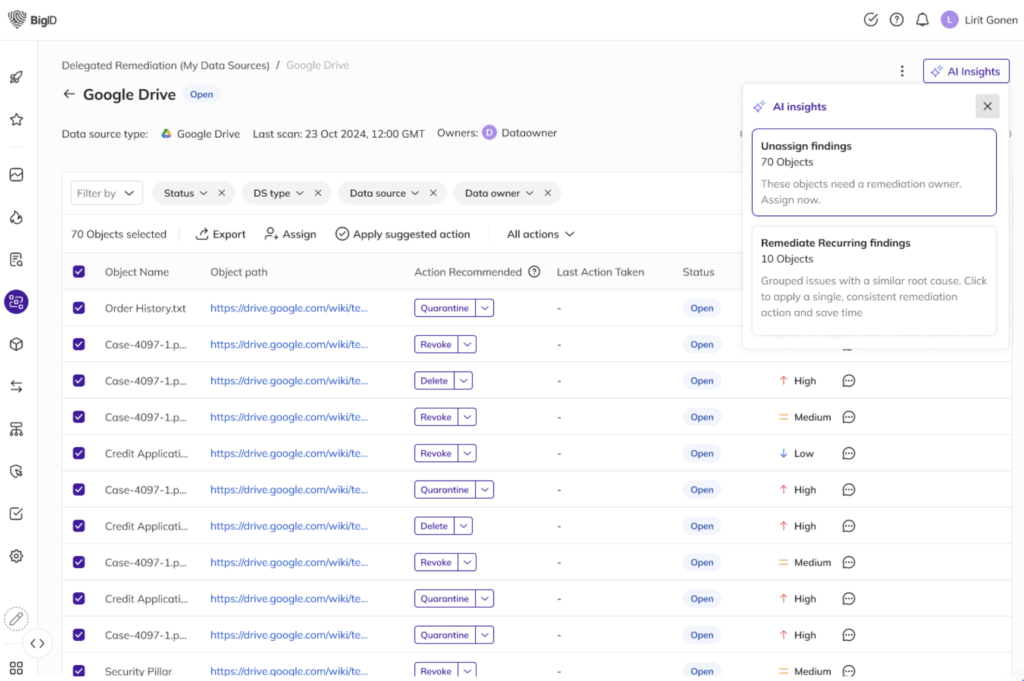
- Priorize objetos de dados de risco com base em sensibilidade, exposição, raio de impacto, caminhos de acesso, uso e configurações incorretas.
- Remover resultados duplicados e agrupar resultados relacionados para reduzir o ruído.
- Identifique o que realmente importa — e o que deve ser corrigido primeiro.
A partir daí, a BigID entrega. orientações de remediação de agentes, encaminhando ações priorizadas para as equipes certas com contexto gerado automaticamente e etapas recomendadas.
Isso muda a abordagem de remediação, passando da gestão reativa de chamados para a redução proativa e inteligente de riscos.
Projetado para colaboração, não para gargalos.
A BigID reconhece que as equipes de segurança não conseguem corrigir tudo sozinhas. Ao direcionar tarefas de correção guiada aos proprietários de dados e aplicativos — com instruções claras e contexto de negócios — a BigID elimina atritos entre as equipes e acelera o tempo de resolução.
Validação contínua e resultados mensuráveis
A remediação não termina com uma ação. O BigID valida continuamente se a exposição foi reduzida e se mantém reduzida ao longo do tempo, fornecendo provas mensuráveis de melhoria para líderes de segurança, auditores e equipes de governança.
Indo além das multas para uma verdadeira remediação do DSPM
Os sistemas de emissão de tickets foram criados para rastrear o trabalho, não para reduzir o risco de dados em grande escala.
À medida que o volume de dados aumenta e a adoção da IA se acelera, as organizações precisam Soluções DSPM que vão além:
- De alertas a ações priorizadas
- Do esforço manual à automação inteligente
- Da conclusão da tarefa à redução comprovada do risco.
A BigID proporciona essa mudança com remediação flexível, orientação inteligente e remediação automatizada, transformando insights do DSPM em resultados de segurança reais e mensuráveis.
Porque na escala do DSPM, a remediação não se resume à gestão de chamados.
Trata-se de reduzir o risco — de forma contínua e inteligente.
Quer saber mais? Agende uma reunião individual com um de nossos especialistas em DSPM hoje mesmo!
Autor