
Ir al contenido

Hogar » Cobertura de datos » Amazon S3

Amazon S3 Data Discovery and Classification

Visibilidad completa Al otro lado de Amazon S3 Buckets

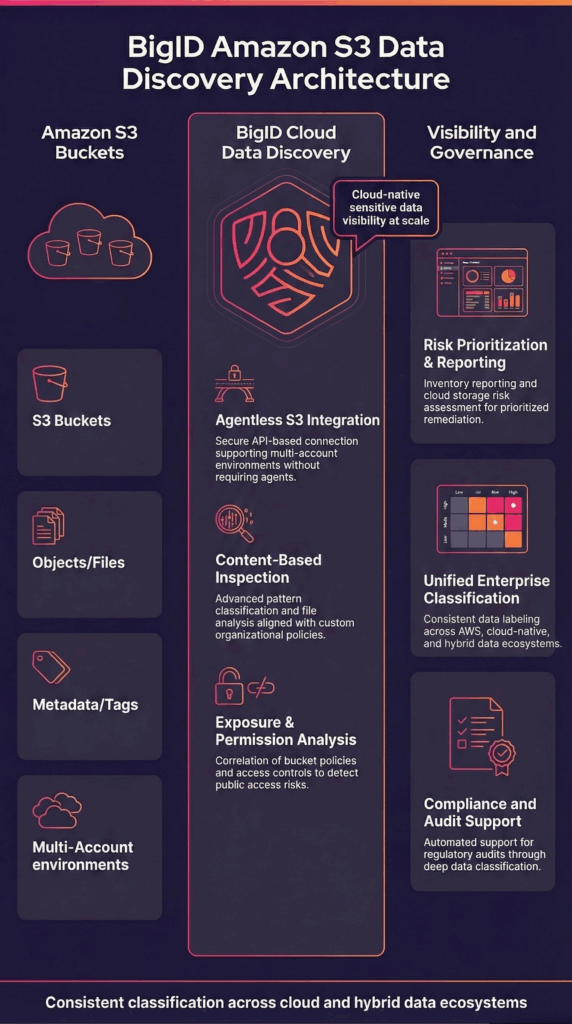
Amazon S3 stores massive volumes of structured and unstructured data across object storage environments. BigID delivers content-based Amazon S3 data discovery and sensitive data classification so organizations can identify regulated, confidential, and high-risk data across cloud storage at scale.

Descubrimiento de datos Across Amazon S3

BigID connects securely to Amazon S3 using agentless integration to scan object content and associated metadata. It inspects actual data values inside S3 objects to identify sensitive and regulated information while correlating findings with access and exposure context.

BigID admite el descubrimiento en:

  • S3 buckets and objects
  • Structured and unstructured file formats
  • Metadata and object tags
  • Encrypted S3 environments
  • Large-scale, multi-account AWS deployments

Discovery results integrate with governance workflows, risk prioritization, and enterprise-wide classification policies.

This architecture ensures scalable S3 data discovery across dynamic cloud environments.

En Ventaja de BigID for AWS S3

Deep Content-Level Object Inspection

S3 stores diverse file types across distributed buckets. BigID analyzes:

  • Documents, spreadsheets, and PDFs
  • Logs and semi-structured files
  • Data exports and archives
  • Application-generated files
  • Structured data within object storage

BigID inspects file content, not just object metadata, for high-confidence sensitive data identification.

Sensitive Data Classification at Cloud Scale

BigID identifica y clasifica:

  • Datos personales bajo las regulaciones globales de privacidad
  • Información financiera y de pagos
  • Health and industry-regulated data
  • Información de empleados y RR.HH.
  • Proprietary and confidential enterprise content
  • Custom-defined sensitive attributes

Classification applies consistently across S3 and the broader cloud ecosystem.

Exposure and Access Risk Visibility

Cloud storage risk often stems from misconfigured buckets and excessive access.

BigID enhances S3 discovery with:

  • Bucket permission visibility
  • Public or externally accessible object detection
  • Access control correlation
  • Análisis de volumen y concentración de datos

Security teams gain insight into where sensitive S3 data may be overexposed.

Scalable and Performance-Aware Cloud Scanning

S3 environments can contain billions of objects.

BigID admite:

  • Alcance del escaneo y programación configurables
  • Sampling options for large datasets
  • Escaneo consciente del rendimiento
  • Multi-account AWS support
  • Cloud-native deployment models

Organizations achieve scalable discovery without disrupting cloud workloads.

Ventajas técnicas

Content-Based Object Scanning

Inspects actual S3 object content and metadata to detect sensitive data accurately.

Cloud-Scale Performance

Supports large, distributed S3 environments with configurable scanning controls.

Exposure and Permission Analysis

Identifies publicly accessible or over-permissioned sensitive objects.

Unified Cloud Classification

Extends S3 discovery results across AWS, SaaS, data lakes, and AI environments.

Amazon S3 Data Discovery and Classification FAQs

Does BigID scan S3 at the content level or metadata level?
BigID performs content-based scanning of S3 objects and also analyzes metadata and access configurations to provide accurate sensitive data identification and exposure visibility.
Can BigID detect publicly exposed sensitive S3 objects?
Yes. BigID provides visibility into bucket permissions and object accessibility to highlight sensitive data that may be publicly or externally exposed.
How does BigID scale across large S3 environments?
BigID supports configurable scan scope, sampling options, scheduling controls, and multi-account AWS deployments to scale across large object storage environments.
What file types can BigID scan in Amazon S3?
BigID supports scanning structured and unstructured file types, including documents, PDFs, logs, exports, and other common data formats stored in object storage.
How do teams use S3 discovery results?
Teams use BigID to generate sensitive data inventories, prioritize cloud storage risk, validate policy alignment, and support compliance initiatives across AWS environments.

Visite Visibilidad clara Al otro lado de Amazon S3

Amazon S3 powers modern cloud storage and analytics. BigID ensures sensitive data across S3 remains visible, classified, and aligned to enterprise governance policies.

Liderazgo en el sector